
|
You entered: color
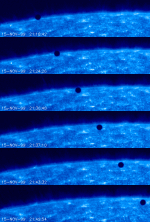 Mercury And The Sun
18.11.1999
Just days before the peak of the Leonid meteor shower, skywatchers were offered another astronomical treat as planet Mercury crossed the face of the Sun on November 15. Viewed from planet Earth, a transit of Mercury is not all that rare. The last occurred in 1993 and the next will happen in 2003.
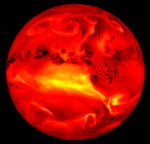 The Water Vapor Channel
4.09.1999
What alien planet's bizarre landscape lurks below these fiery-looking clouds? It's only Planet Earth, of course ... as seen on the Water Vapor Channel. Hourly, images like this one (an infrared image shown in false color) are brought to you by the orbiting Geostationary Operational Environmental Satellites' (GOES) multi-channel imagers.
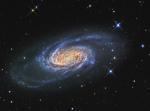 Bright Galaxy NGC 2903
6.07.2007
Spiral galaxy NGC 2903 is only some 20 million light-years distant in the constellation Leo. One of the brighter galaxies visible from the northern hemisphere, it is surprisingly missing from Charles Messier's famous catalog of celestial sights. This impressively sharp color image shows off the galaxy's beautiful blue spiral arms.
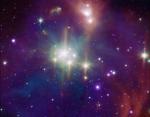 Coronet in the Southern Crown
21.09.2007
X-rays from young stars and infrared light from stars and cosmic dust are combined in this false color image of a star-forming region in Corona Australis, the Southern Crown. The small star grouping is fittingly known as the Coronet Cluster.
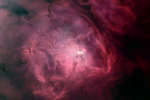 Gas and Dust of the Lagoon Nebula
15.07.2008
This beautiful cosmic cloud is a popular stop on telescopic tours of the constellation Sagittarius. Eighteenth century cosmic tourist Charles Messier cataloged the bright nebula as M8, while modern day astronomers recognize the Lagoon...
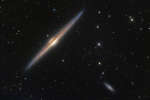 NGC 4565: Galaxy on Edge
15.10.2011
Magnificent spiral galaxy NGC 4565 is viewed edge-on from planet Earth. Also known as the Needle Galaxy for its narrow profile, bright NGC 4565 is a stop on many telescopic tours of the northern sky, in the faint but well-groomed constellation Coma Berenices.
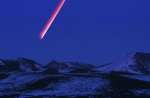 Red Moon Rising
16.12.2011
This surreal, wintry scene is a composite picture recorded on December 10 as the Moon rose behind the Zagros Mountains of Iran. A total lunar eclipse was already in progress. The image combines nearly 500 successive frames taken over 1.5 hours beginning in twilight as the eclipsed Moon steadily climbed above the rugged landscape.
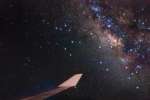 New York to London Milky Way
14.06.2014
Bright stars of Sagittarius and the center of our Milky Way Galaxy lie just off the wing of a Boeing 747 in this astronomical travel photo. The stratospheric scene was captured earlier this month during a flight from New York to London, 11,0000 meters above the Atlantic Ocean.
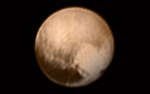 5 Million Miles from Pluto
8.07.2015
An image snapped on July 7 by the New Horizons spacecraft while just under 5 million miles (8 million kilometers) from Pluto is combined with color data in this most detailed view yet of the Solar System's most famous world about to be explored.
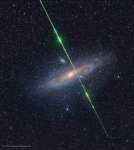 Meteor before Galaxy
16.08.2016
What's that green streak in front of the Andromeda galaxy? A meteor. While photographing the Andromeda galaxy last Friday, near the peak of the Perseid Meteor Shower, a sand-sized rock from deep space crossed right in front of our Milky Way Galaxy's far-distant companion.
|
January February March April May June July August September October |
|||||||||||||||||||||||||||||||||||||||||||||||||