
|
You entered: color
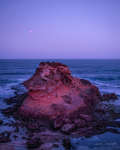 Red Planet Red Moon and Mars
9.08.2018
Mars is also known as The Red Planet, often seen with a reddish tinge in dark night skies. Mars shines brightly at the upper left of this gorgeous morning twilight view from Mornington Peninsula, Victoria, Australia, but the Moon and planet Earth look redder still. Taken on July 27, the totally eclipsed Moon is setting.
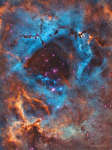 APOD: 2023 February 6 Б In the Heart of the Rosette Nebula
6.02.2023
In the heart of the Rosette Nebula lies a bright cluster of stars that lights up the nebula. The stars of NGC 2244 formed from the surrounding gas only a few million years ago.
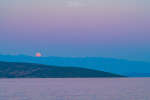 APOD: 2026 August 1 Б Buck Moon and Belt of Venus
1.08.2026
The Buck Moon is a traditional name for the full moon of July. In this colorful Adriatic sea and skyscape captured on July 28 from Krk Island along the coast of Croatia, a full Buck Moon is just rising over distant mountains.
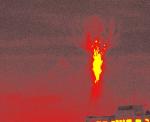 Burning Tree Sprite
2.08.2001
This dramatic, garishly colored image was captured with a low-light level camera on 2001 June 7. It shows what appears to be a "burning tree" above the National Cheng Kung University campus in Tainan City, Taiwan ... but the burning tree is actually a fleeting red sprite 300 kilometers away.
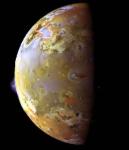 Io: The Prometheus Plume
22.06.2002
Two sulfurous eruptions are visible on Jupiter's volcanic moon Io in this color composite Galileo image. On the left, over Io's limb, a new bluish plume rises about 86 miles above the surface of a volcanic caldera known as Pillan Patera.
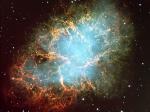 The Crab Nebula from VLT
14.09.2003
The Crab Nebula, filled with mysterious filaments, is the result of a star that was seen to explode in 1054 AD. This spectacular supernova explosion was recorded by Chinese and (quite probably) Anasazi Indian astronomers.
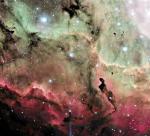 Close Up of the Lagoon Nebula
16.08.2004
Stars are battling gas and dust in the Lagoon Nebula but the photographers are winning. Also known as M8, this photogenic nebula is visible even without binoculars towards the constellation of Sagittarius. The energetic processes of star formation create not only the colors but the chaos.
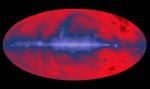 The Radio Sky: Tuned to 408MHz
5.02.2005
Tune your radio telescope to 408MHz (408 million cycles per second) and check out the Radio Sky! In the 1970s large dish antennas at three radio observatories, Jodrell Bank, MPIfR, and Parkes Observatory, were used to do just that - the data were combined to map the entire sky.
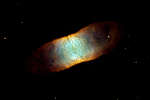 IC 4406: A Seemingly Square Nebula
27.07.2008
How can a round star make a square nebula? This conundrum comes to light when studying planetary nebulae like IC 4406. Evidence indicates that IC 4406 is likely a hollow cylinder, with its square appearance the result of our vantage point in viewing the cylinder from the side.
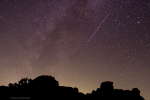 Perseid Trail
14.08.2008
This bright and colorful meteor flashed through Tuesday's early morning skies, part of the annual Perseid Meteor Shower. The lovely image is one of over 350 frames captured on August 12 from...
|
January February March April May June July August September October |
|||||||||||||||||||||||||||||||||||||||||||||||||