
|
You entered: dust
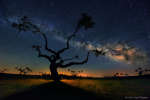 The Galaxy Tree
25.05.2015
First came the trees. In the town of Salamanca, Spain, the photographer noticed how distinctive a grove of oak trees looked after being pruned. Next came the galaxy. The photographer stayed up until 2 am, waiting until the Milky Way Galaxy rose above the level of a majestic looking oak.
 M7: Open Star Cluster in Scorpius
13.07.2016
M7 is one of the most prominent open clusters of stars on the sky. The cluster, dominated by bright blue stars, can be seen with the naked eye in a dark sky in the tail of the constellation of the Scorpion (Scorpius).
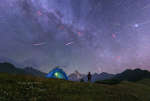 Meteors over Four Girl Mountains
13.12.2016
On some nights it rains meteors. Peaking over the next two nights, asteroid dust is expected to rain down on Earth during the annual Geminids meteor shower. This year, unfortunately, fainter Geminids will be harder to see because of the brightness of the Long Nights Full Moon, which occurs Wednesday.
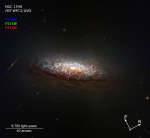 Hubble s NGC 1546
21.06.2024
Returning to science operations on June 14, the Hubble Space Telescope used its new pointing mode to capture this sharp image of spiral galaxy NGC 1546. A member of the Dorado galaxy group, the island universe lies a mere 50 million light-years away.
 APOD: 2025 July 11 Б The Veins of Heaven
11.07.2025
Transfusing sunlight as the sky grew darker, this exceptional display of noctilucent clouds was captured on July 10, reflected in the calm waters of Vallentuna Lake near Stockholm, Sweden. From the edge of space...
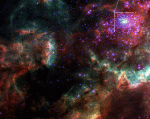 In the Center of 30 Doradus
4.10.1997
In the center of 30 Doradus lies a huge cluster of the largest, hottest, most massive stars known. The center of this cluster, known as R136, is boxed in the upper right portion of the above picture.
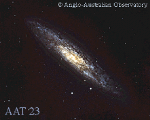 Spiral Galaxy NGC 253 Almost Sideways
2.11.1996
NGC 253 is a normal spiral galaxy seen here almost sideways. It is the largest member of the Sculptor Group of Galaxies, the nearest group to our own Local Group of Galaxies.
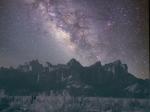 Heaven on Earth
23.02.2004
If sometimes it appears that the entire Milky Way Galaxy is raining down on your head, do not despair. It happens twice a day. As the Sun rises in the East, wonders of the night sky become less bright than the sunlight scattered by our own Earth's atmosphere, and so fade from view.
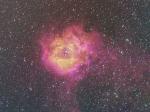 The Rosette Nebula
14.02.2005
Would the Rosette Nebula by any other name look as sweet? The bland New General Catalog designation of NGC 2237 doesn't appear to diminish the appearance of the this flowery emission nebula. Inside the nebula lies an open cluster of bright young stars designated NGC 2244.
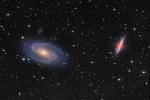 Galaxy Wars: M81 versus M82
15.04.2006
In this stunning cosmic vista, galaxy M81 is on the left surrounded by blue spiral arms. On the right marked by massive gas and dust clouds, is M82. These two mammoth galaxies have been locked in gravitational combat for the past billion years.
|
January February March April May June July August September October |
|||||||||||||||||||||||||||||||||||||||||||||||||