
|
You entered: dust
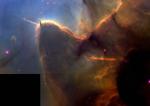 Starbirth in the Trifid Nebula
7.06.1999
Tremendous pillars of gas and dust are being boiled away in the Trifid Nebula. In the center of the picturesque Trifid lies a young hot star, located above and to the right of this picture. As soon as it was born, the massive star scorched its surroundings with bright and
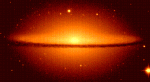 M104: The Sombrero Galaxy
9.11.1995
The famous Sombrero galaxy (M104) is a bright nearby spiral galaxy. The prominent dust lane and halo of stars and globular clusters give this galaxy its name. Something very energetic is going on in the Sombrero's center, as much X-ray light has been detected from it.
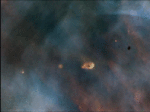 Proplyds: Infant Solar Systems?
17.10.1996
Are planets common in our galaxy? Strong evidence that the answer is "yes" was provided in this 1994 image made by the Hubble Space Telescope . A close-up of the Orion Nebulae, it reveals what seem to be disks of dust and gas surrounding newly formed stars.
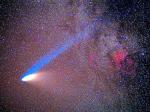 Comet Hale Bopp and the North America Nebula
3.10.2004
Comet Hale-Bopp's 1997 encounter with the inner Solar System allowed many breath-taking pictures. Above, Comet Hale-Bopp was photographed crossing the constellation of Cygnus, sporting spectacular yellow dust and blue ion tails. Visible on the right in red is the North America Nebula, a bright emission nebula observable from a dark location with binoculars.
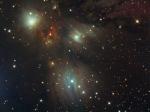 Still Life with NGC 2170
5.08.2006
In this beautiful celestial still life composed with a cosmic brush, dusty nebula NGC 2170 shines at the upper left. Reflecting the light of nearby hot stars, NGC 2170 is joined by other bluish reflection nebulae and a compact red emission region against a backdrop of stars.
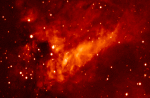 M17: The Majestic Swan Nebula
29.08.1996
What unusual eggs have been laid by this majestic swan? The star forming region above, known as Swan Nebula, is the home of hot red-glowing gas, dark lanes of dust, bright young stars and -- what are those?
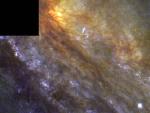 NGC 253: The Sculptor Galaxy
16.03.2003
NGC 253 is not only one of the brightest spiral galaxies visible, it is also one of the dustiest. Discovered in 1783 by Caroline Herschel in the constellation of Sculptor, NGC 253 lies only about ten million light-years distant.
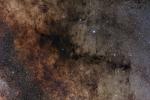 East of Antares
23.06.2006
East of Antares, dark markings seem to sprawl through the crowded star fields toward the center of our Milky Way Galaxy. Cataloged in the early 20th century by astronomer E. E. Barnard, the obscuring interstellar dust clouds include B72, B77, B78, and B59, seen in silhouette against the starry background.
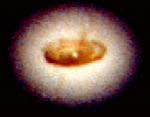 The Heart Of NGC 4261
7.11.1999
Who knows what evil lurks in the hearts of galaxies? The Hubble knows. This Hubble Space Telescope picture of the center of the nearby elliptical galaxy NGC 4261 tells one dramatic tale. The gas and dust in this disk are swirling into what is almost certainly a massive black hole.
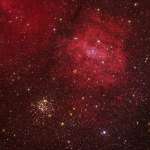 The Bubble and M52
30.10.2009
To the eye, this cosmic composition nicely balances the Bubble Nebula at the upper right with open star cluster M52. The pair would be lopsided on other scales, though. Embedded in a complex...
|
January February March April May June July August September October |
|||||||||||||||||||||||||||||||||||||||||||||||||