
|
You entered: dust
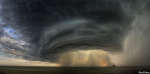 A Supercell Thunderstorm Cloud Over Montana
5.05.2013
Is that a spaceship or a cloud? Although it may seem like an alien mothership, it's actually a impressive thunderstorm cloud called a supercell. Such colossal storm systems center on mesocyclones -- rotating updrafts that can span several kilometers and deliver torrential rain and high winds including tornadoes.
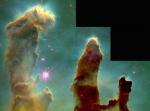 M16: Stars from Eagle's EGGs
25.11.2001
Newborn stars are forming in the Eagle Nebula. This image, taken with the Hubble Space Telescope in 1995, shows evaporating gaseous globules (EGGs) emerging from pillars of molecular hydrogen gas and dust. The giant pillars are light years in length and are so dense that interior gas contracts gravitationally to form stars.
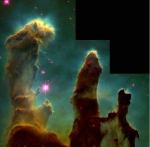 M16: Stars from Eagle's Eggs
24.09.2000
Newborn stars are forming in the Eagle Nebula. This image, taken with the Hubble Space Telescope in 1995, shows evaporating gaseous globules (EGGs) emerging from pillars of molecular hydrogen gas and dust. The giant pillars are light years in length and are so dense that
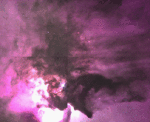 A Close-Up of the Lagoon Nebula
20.08.1996
Ribbons of red-glowing gas and dark dust surround massive young stars in this close-up of the Lagoon Nebula taken by the Hubble Space Telescope. The Lagoon Nebula is relatively close and bright - it appears larger than the Full Moon and is visible even without a telescope.
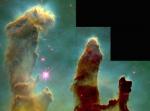 M16: Stars from Eagles EGGs
26.10.2003
Newborn stars are forming in the Eagle Nebula. This image, taken with the Hubble Space Telescope in 1995, shows evaporating gaseous globules (EGGs) emerging from pillars of molecular hydrogen gas and dust. The giant pillars are light years in length and are so dense that interior gas contracts gravitationally to form stars.
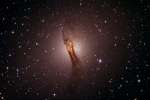 Centaurus A
13.03.2010
Only 11 million light-years away, Centaurus A is the closest active galaxy to planet Earth. Spanning over 60,000 light-years, the peculiar elliptical galaxy, also known as NGC 5128, is featured in this sharp color image.
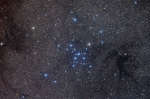 M7: Open Star Cluster in Scorpius
12.09.2012
M7 is one of the most prominent open clusters of stars on the sky. The cluster, dominated by bright blue stars, can be seen with the naked eye in a dark sky in the tail of the constellation of the Scorpion (Scorpius).
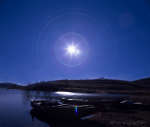 Meteors vs Supermoon
16.12.2016
Geminid meteors battled supermoonlight in planet Earth's night skies on December 13/14. Traveling at 35 kilometers (22 miles) per second, the bits of dust from the mysterious asteroid 3200 Phaethon that produce the meteor streaks are faster than a speeding bullet.
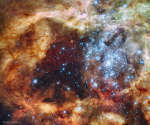 Star Cluster R136 Breaks Out
10.01.2021
In the center of nearby star-forming region lies a huge cluster containing some of the largest, hottest, and most massive stars known. These stars, known collectively as star cluster R136, part of the Tarantula Nebula, were captured in the featured image in visible light in 2009 through the Hubble Space Telescope.
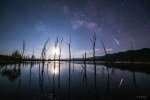 Lyrid of the Lake
28.04.2022
In the early hours of April 24 this bright Lyrid meteor flashed along the central Milky Way. For a moment, it cast a bright reflection across Lake Nian, Yunnan province, China. The annual Lyrid...
|
January February March April May June July August September October |
|||||||||||||||||||||||||||||||||||||||||||||||||