
|
You entered: dust
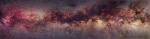 A Milky Way Band
5.06.2005
Most bright stars in our Milky Way Galaxy reside in a disk. Since our Sun also resides in this disk, these stars appear to us as a diffuse band that circles the sky.
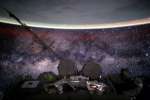 Earth and Milky Way from Space
7.11.2015
Since November 2000, people have been living continuously on the International Space Station. To celebrate humanity's 15th anniversary off planet Earth, consider this snapshot from space of our galaxy and our home world posing together beyond the orbital outpost.
 APOD: 2024 July 29 Б Milky Way over Uluru
29.07.2024
What's happening above Uluru? A United Nations World Heritage Site, Uluru is an extraordinary 350-meter high mountain in central Australia that rises sharply from nearly flat surroundings. Composed of sandstone, Uluru has slowly formed over the past 300 million years as softer rock eroded away.
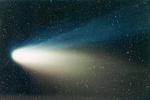 Comet Hale-Bopp's Developing Tail
14.03.1997
Comet Hale-Bopp is living up to its expectations. Besides the brightness of its coma, a comet is typically remembered by the length of its tails. As visible in the above picture taken last week, Comet Hale-Bopp's blue ion tail shows a dramatic extension, with current reports of about 20 degrees from dark locations.
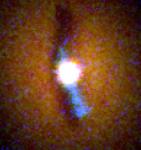 The Center of NGC 6251 is Glowing
12.09.1997
Something is lighting up the center of galaxy NGC 6251. Leading speculation holds that it is a large black hole not shrouded by gas and dust typically found near the center of a galaxy.
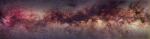 A Milky Way Band
30.09.2007
Most bright stars in our Milky Way Galaxy reside in a disk. Since our Sun also resides in this disk, these stars appear to us as a diffuse band that circles the sky.
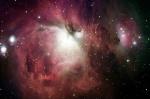 The Orion Nebula in Hydrogen
22.11.2000
The Great Nebula in Orion can be found just below and to the left of the easily identifiable belt of three stars in the popular constellation Orion. This fuzzy patch, visible to the unaided eye, contains one of the closest stellar nurseries, lying at a distance of about 1500 light years.
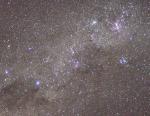 The Southern Sky from the International Space Station
7.05.2003
Look up from Earth's South Pole, and this stellar starscape is what you might see. Alternatively, this patch of sky is also visible from many southern locations as well as the orbiting International Space Station, where the above image was recently recorded.
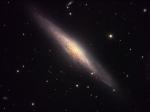 NGC 2683: Spiral Edge On
27.11.2004
This gorgeous island universe, cataloged as NGC 2683, lies a mere 16 million light-years distant in the northern constellation Lynx. A spiral galaxy comparable to our own Milky Way, NGC 2683 is seen nearly edge-on in this cosmic vista, with more distant galaxies scattered in the background.
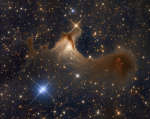 Ghost of the Cepheus Flare
30.10.2010
Spooky shapes seem to haunt this starry expanse, drifting through the night in the royal constellation Cepheus. Of course, the shapes are cosmic dust clouds faintly visible in dimly reflected starlight. Far from your...
|
January February March April May June July August September October |
|||||||||||||||||||||||||||||||||||||||||||||||||