
|
You entered: dust
 APOD: 2025 July 23 Б Fireball over Cape San Blas
22.07.2025
Have you ever seen a fireball? In astronomy, a fireball is a very bright meteor -- one at least as bright as Venus and possibly brighter than even a full Moon. Fireballs are rare -- if you see one you are likely to remember it for your whole life.
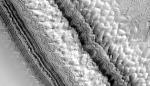 Layers of the Martian South Polar Cap
25.04.2000
The South Pole of Mars is stranger than was previously thought. Pictured above are unexpectedly complex layers photographed recently by the Mars Global Surveyor spacecraft currently orbiting Mars. The layers probably include carbon dioxide ice, water ice, rock and dust.
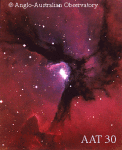 Hot Stars in the Trifid Nebula
20.12.1995
In the center of the glowing red gas on the Trifid Nebula lies an open cluster of young hot stars. The energetic light from these stars strikes hydrogen atoms in the surrounding nebula causing them to lose their electrons.
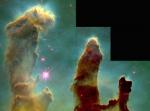 M16: Stars from Eagle's EGGs
24.04.2005
Newborn stars are forming in the Eagle Nebula. This image, taken with the Hubble Space Telescope in 1995, shows evaporating gaseous globules (EGGs) emerging from pillars of molecular hydrogen gas and dust. The giant pillars are light years in length and are so dense that interior gas contracts gravitationally to form stars.
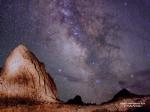 The Milky Way over Utah
1.08.2006
If sometimes it appears that the entire Milky Way Galaxy is raining down on your head, do not despair. It happens twice a day. As the Sun rises in the East, wonders of the night sky become less bright than the sunlight scattered by our own Earth's atmosphere, and so fade from view.
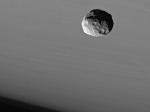 Janus: Potato Shaped Moon of Saturn
6.11.2006
Janus is one of the stranger moons of Saturn. First, Janus travels in an unusual orbit around Saturn where it periodically trades places with its sister moon Epimetheus, which typically orbits about 50 kilometers away. Janus, although slightly larger than Epimetheus, is potato-shaped and has a largest diameter of about 190 kilometers.
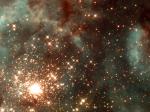 Star Cluster R136 Bursts Out
6.05.2007
In the center of star-forming region 30 Doradus lies a huge cluster of the largest, hottest, most massive stars known. These stars, known as the star cluster R136, and part of the surrounding nebula are captured here in this gorgeous visible-light image from the Hubble Space Telescope.
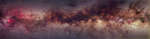 A Milky Way Band
10.07.2011
Most bright stars in our Milky Way Galaxy reside in a disk. Since our Sun also resides in this disk, these stars appear to us as a diffuse band that circles the sky.
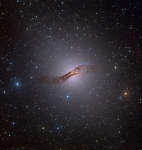 Centaurus A
16.03.2022
A mere 11 million light-years away, Centaurus A is the closest active galaxy to planet Earth. Spanning over 60,000 light-years, the peculiar elliptical galaxy also known as NGC 5128, is featured in this sharp telescopic view.
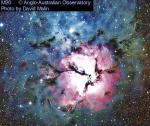 M20: The Trifid Nebula
31.03.1998
Unspeakable beauty and unimaginable bedlam can be found together in the Trifid Nebula. Also known as M20, this photogenic nebula is visible with good binoculars in the constellation of Sagittarius. The energetic processes of star formation create not only the colors but the chaos. The red-glowing gas results from high-energy light striking interstellar hydrogen gas.
|
January February March April May June July August September October |
|||||||||||||||||||||||||||||||||||||||||||||||||