
|
You entered: dust
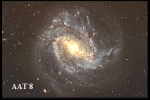 Spiral Galaxy M83
19.04.1997
The long winding arms of this nearby spiral galaxy define it as the "Southern Pinwheel." But M83 is quite a typical spiral - much like our own Milky Way Galaxy. Spiral galaxies contains many billions of stars, the youngest of which inhabit the spiral arms and glow strongly in blue light.
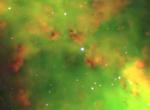 In the Center of the Dumbbell Nebula
13.10.1998
Here's part of the Dumbbell Nebula that you can't see through binoculars. To see this, we suggest a sophisticated spectrograph attached to a telescope with an 8-meter aperture. Pictured above is the central part of the Dumbbell Nebula, also known as M27 and NGC 6853.
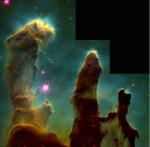 Stars from Eagles Eggs
2.05.1999
Newborn stars are forming in the Eagle Nebula. This image, taken with the Hubble Space Telescope in 1995, shows evaporating gaseous globules (EGGs) emerging from pillars of molecular hydrogen gas and dust. The giant pillars are light years in length and are so dense that interior gas contracts gravitationally to form stars.
 The Dark River to Antares
3.06.2008
Connecting the Pipe Nebula to the bright star Antares is a flowing dark cloud nicknamed the Dark River. The murkiness of the Dark River is caused by absorption of background starlight by dust, although the nebula contains mostly hydrogen and molecular gas.
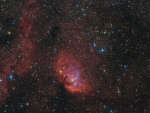 The Tulip in the Swan
21.09.2019
Framing a bright emission region, this telescopic view looks out across a pretty field of stars along the plane of our Milky Way Galaxy, toward the nebula rich constellation Cygnus the Swan. Popularly called...
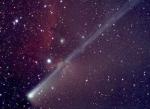 Comet SOHO and Nebulae in Orion
4.06.1998
Astrophotographer Michael Horn captured this gorgeous view of comet SOHO in the dark night sky above Wandibindle, Queensland, Australia on May 23rd. On this date, comet SOHO was moving against the background of the nebula-rich constellation of Orion.
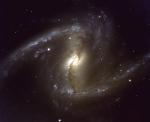 NGC 1365: A Nearby Barred Spiral Galaxy
24.06.1999
Many spiral galaxies have bars across their centers. Even our own Milky Way Galaxy is thought to have a bar, but perhaps not so prominent as the one in NGC 1365, shown above. The persistence and motion of the bar imply relatively massive spiral arms.
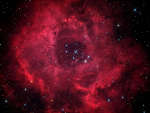 The Rosette Nebula
14.02.2012
The Rosette Nebula is not the only cosmic cloud of gas and dust to evoke the imagery of flowers -- but it is the most famous. At the edge of a large molecular cloud...
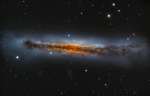 Edge on NGC 3628
20.06.2013
Sharp telescopic views of magnificent edge-on spiral galaxy NGC 3628 show a puffy galactic disk divided by dark dust lanes. Of course, this deep galactic portrait puts some astronomers in mind of its popular moniker, The Hamburger Galaxy.
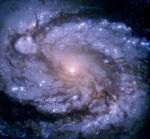 M100: A Grand Design
1.06.1997
Majestic on a truly cosmic scale, M100 is appropriately known as a Grand Design spiral galaxy. A large galaxy of over 100 billion or so stars with well defined spiral arms, it is similar to our own Milky Way.
|
January February March April May June July August September October |
|||||||||||||||||||||||||||||||||||||||||||||||||