
|
You entered: NASA
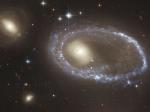 Ring Galaxy AM 0644 741 from Hubble
26.04.2004
How could a galaxy become shaped like a ring? The rim of the blue galaxy pictured on the right is an immense ring-like structure 150,000 light years in diameter composed of newly formed, extremely bright, massive stars.
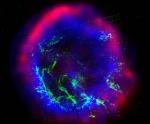 Supernova Remnant E0102 72 from Radio to X-Ray
14.04.2000
Not all stars form a big Q after they explode. The shape of supernova remnant E0102-72, however, is giving astronomers a clue about how tremendous explosions disperse elements and interact with surrounded gas. The above image is a composite of three different photographs in three different types of light.
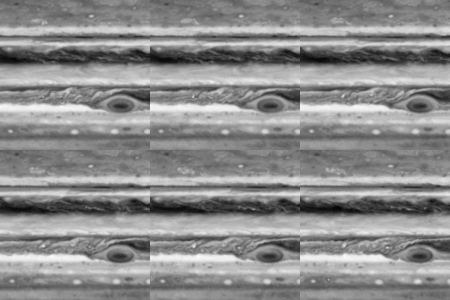 Cassini At Jupiter: Red Spot Movie
23.11.2000
Everything is big on Jupiter, the solar system's reigning gas giant. For example, Jupiter's Great Red Spot is a hurricane-like storm system at least twice the diameter of planet Earth. Approaching Jupiter...
 AR9077: Solar Magnetic Arcade
20.07.2000
On July 14th, solar active region 9077 (AR9077) produced a massive flare. The event also blasted an enormous cloud of energetic charged particles toward planet Earth, triggering magnetic storms and dramatic auroral displays. This striking close-up of AR9077 was made by the orbiting TRACE satellite shortly after the flare erupted.
 Blue Stragglers In NGC 6397
22.06.2000
In our neck of the Galaxy stars are too far apart to be in danger of colliding, but in the dense cores of globular star clusters star collisions may be relatively common. In fact...
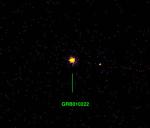 GRB010222: Gamma Ray Burst, X Ray Afterglow
13.04.2001
A fading afterglow from one of the most powerful explosions in the universe is centered in this false color image from the spacebased Chandra X-ray Observatory. The cosmic explosion, an enormously bright gamma-ray burst (GRB), originated in a galaxy billions of light-years away and was detected by the BeppoSAX satellite on February 22.
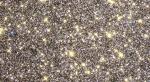 The Center of Globular Cluster Omega Centauri
10.10.2001
What is left over after stars collide? To help answer this question, astronomers have been studying the center of the most massive ball of stars in our Milky Way Galaxy. In the center of globular cluster Omega Centauri, stars are packed in 10,000 times more densely than near our Sun.
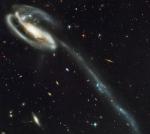 Arp 188 and the Tadpole s Tidal Tail
2.05.2002
In this stunning vista recorded with the Hubble Space Telescope's new advanced camera, distant galaxies form a dramatic backdrop for disrupted spiral galaxy Arp 188, the Tadpole Galaxy. The cosmic Tadpole is a mere 420 million light-years distant toward the northern constellation Draco.
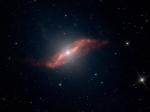 The Galaxy Within Centaurus A
24.06.2004
Peering deep inside Centaurus A, the closest active galaxy to Earth, the Spitzer Space Telescope's penetrating infrared cameras recorded this startling vista. About 1,000 light-years across, the twisted cosmic dust cloud apparently shaped like a parallelogram is likely the result of a smaller spiral galaxy falling into the giant Centaurus A.
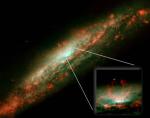 The Bubbling Cauldron of NGC 3079
16.10.2004
Edge-on spiral galaxy NGC 3079 is a mere 50 million light-years away toward the constellation Ursa Major. Shown in this stunning false-color Hubble Space Telescope image, the galaxy's disk - composed of spectacular star clusters in winding spiral arms and dramatic dark lanes of dust - spans some 70,000 light-years.
|
January February March April May June July August September October |
|||||||||||||||||||||||||||||||||||||||||||||||||