
|
You entered: NASA
 CMBR Dipole: Speeding Through the Universe
8.10.2006
Our Earth is not at rest. The Earth moves around the Sun. The Sun orbits the center of the Milky Way Galaxy. The Milky Way Galaxy orbits in the Local Group of Galaxies. The Local Group falls toward the Virgo Cluster of Galaxies.
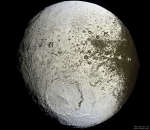 APOD: 2026 July 5 Б Saturns Iapetus: Painted Moon
4.07.2026
What has happened to Saturn's moon Iapetus? Vast sections of this strange world are dark as coal, while others are as bright as snow. To help better understand this unusually tinted moon, in 2007 NASA directed the robotic Cassini spacecraft then orbiting Saturn to swoop within 2,000 kilometers.
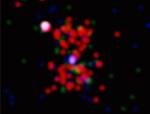 3C294: Distant X Ray Galaxy Cluster
21.02.2001
Large clusters of galaxies are the most massive objects in the universe. Astronomers now realize that a hallmark of these cosmic behemoths are gas clouds with temperatures of tens of millions of degrees that pervade the clusters and radiate strongly in x-rays.
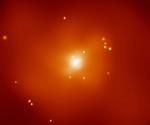 Dark Matter, X rays, and NGC 720
26.10.2002
Elliptical galaxy NGC 720 is enveloped in a cosmic cloud of x-ray emitting gas. Seen in this false color image from the Chandra X-ray Observatory, the extreme temperature of the gas - about 7 million...
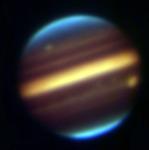 WIRO at Jupiter
12.03.2003
Gazing out over the mountaintops from the Wyoming InfraRed Observatory (WIRO), astronomers recently recorded this bizarre looking image of the solar system's ruling planet, gas giant Jupiter. The false-color picture is a composite...
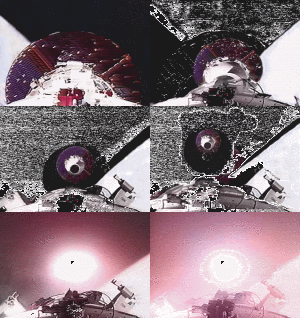 Opportunity Rockets Toward Mars
22.09.2003
Next stop: Mars. Two months ago, the second of two missions to Mars was launched from Cape Canaveral, Florida, USA above a Boeing Delta II rocket. The Mars Exploration Rover dubbed Opportunity is expected to arrive at the red planet this coming January.
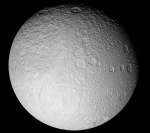 Ice Moon Tethys from Saturn Orbiting Cassini
7.12.2009
What processes formed the unusual surface of Saturn's moon Tethys? To help find out, NASA sent the robotic Cassini spacecraft right past the enigmatic ice moon in 2005. Pictured above is one of the highest resolution images of an entire face of Tethys yet created.
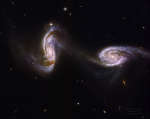 Arp 240: A Bridge between Spiral Galaxies from Hubble
27.11.2016
Why is there a bridge between these two spiral galaxies? Made of gas and stars, the bridge provides strong evidence that these two immense star systems have passed close to each other and experienced violent tides induced by mutual gravity.
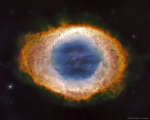 M57: The Ring Nebula
16.04.2018
Except for the rings of Saturn, the Ring Nebula (M57) is probably the most famous celestial band. Its classic appearance is understood to be due to our own perspective, though. The recent mapping...
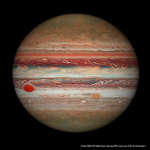 Hubbles Jupiter and the Shrinking Great Red Spot
24.04.2018
What will become of Jupiter's Great Red Spot? Gas giant Jupiter is the solar system's largest world with about 320 times the mass of planet Earth. Jupiter is home to one of the largest and longest lasting storm systems known, the Great Red Spot (GRS), visible to the left.
|
January February March April May June July August September October |
|||||||||||||||||||||||||||||||||||||||||||||||||