
|
You entered: NASA
 The Gamma Ray Moon
10.02.1997
What if you could see gamma rays (photons with more than 40 million times the energy of visible light)? If you could, the Moon would appear brighter than the Sun! This startling notion...
 The Coldest Brown Dwarf
30.08.2011
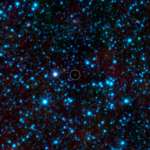
This cosmic snapshot composed with image data from NASA's Wide-field Infrared Survey Explorer (WISE) satellite captures a multitude of faint stars and distant galaxies toward the constellation Lyra at wavelengths longer than visible light. But the object circled at the center is not quite a star.
 Four Planets Orbiting Star HR 8799
1.02.2017
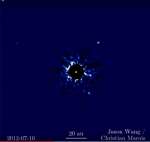
Does life exist outside our Solar System? To help find out, NASA has created the Nexus for Exoplanet System Science (NExSS) to better locate and study distant star systems that hold hope of harboring living inhabitants.
 Our Galaxys Magnetic Center
19.06.2019
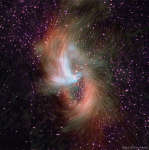
What's the magnetic field like in the center of our Milky Way Galaxy? To help find out, NASA's SOFIA -- an observatory flying in a modified 747 -- imaged the central region with...
 X Ray Mystery in RCW 38
27.12.2002
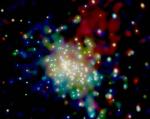
A mere 6,000 light-years distant and sailing through the constellation Vela, star cluster RCW 38 is full of powerful stars. It's no surprise that these stars, only a million years young with hot outer atmospheres, appear as point-like x-ray sources dotting this x-ray image from the orbiting Chandra Observatory.
 Particle Sizes in Saturns Rings
25.05.2005
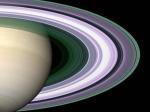
What size particles compose Saturn's rings? To help find out, the robot Cassini spacecraft now orbiting Saturn broadcast radio waves of three different wavelengths right through the rings to Earth earlier this month.
 Survivor: NEAR Shoemaker On Asteroid Eros
5.03.2001
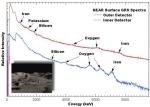
Not part of a television game series, the NEAR Shoemaker spacecraft survived its unprecedented landing on an on asteroid last month. As suggested in the illustration inset above, the car-sized probe likely rests gently on the tips of its solar panels having touched down under the influence of asteroid Eros' feeble gravity.
 M94: Beyond the Blue
13.06.2001
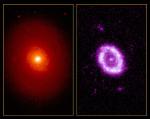
Today's galaxy, M94 (NGC 4736), lies 15 million light-years away in the constellation Canes Venatici. In the red light image (left), its very bright nucleus and tightly wound spiral arms seem to slowly fade into a faint outer disk.
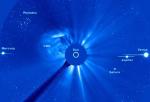 Pleiades, Planets, And Hot Plasma
24.05.2000
Bright stars of the Pleiades, four planets, and erupting solar plasma are all captured in this spectacular image from the space-based SOlar and Heliospheric Observatory (SOHO). In the foreground of the 15 degree wide field of view, a bubble of hot plasma, called a Coronal Mass Ejection (CME)
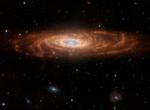 NGC 7331: A Galaxy So Inclined
1.07.2004
If our own Milky Way galaxy were 50 million light-years away with its disk inclined slightly to our line of sight, it would look a lot like large spiral galaxy NGC 7331. In fact...
|
January February March April May June July August September October |
|||||||||||||||||||||||||||||||||||||||||||||||||