
|
You entered: NASA
 Cosmology Solved?
4.11.1998
At the Nature of the Universe Debate held last month at the Smithsonian, top cosmologists P. James E. Peebles (Princeton) and Michael S. Turner (Chicago) argued over whether new data is finally resolving the type of universe in which we live.
 Curiosity Before Mars: Seven Minutes of Terror
31.07.2012
Next week at this time, there may be an amazing new robotic explorer on Mars. Or there may be a new pile of junk. It all likely depends on many things going correctly in the minutes after the Mars Science Laboratory mission arrives at Mars and attempts to deploy the Curiosity rover from orbit.
 The Central Magnetic Field of the Cigar Galaxy
11.03.2019
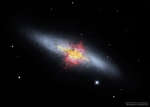
Are galaxies giant magnets? Yes, but the magnetic fields in galaxies are typically much weaker than on Earth's surface, as well as more complex and harder to measure. Recently, though, the HAWC+ instrument...
 Ganymede from Juno
14.06.2021
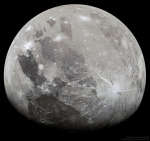
What does the largest moon in the Solar System look like? Jupiter's moon Ganymede, larger than even Mercury and Pluto, has an icy surface speckled with bright young craters overlying a mixture of older, darker, more cratered terrain laced with grooves and ridges.
 SN 1006: Pieces of the Cosmic Ray Puzzle
2.12.2000
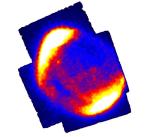
Research balloon flights conducted in 1912 by Austrian physicist Victor Hess revealed that the Earth was constantly bombarded by high energy radiation from space - which came to be called "Cosmic Rays". What are Cosmic Rays and where do they come from?
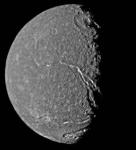 Titania's Trenches
11.01.1997
British astronomer Sir William Herschel discovered Titania and Oberon in 1787, 210 years ago today. He wasn't reading Shakespeare's A Midsummer Night's Dream though, he was making the first telescopic observations of moons of the planet Uranus (a planet which he himself discovered in 1781).
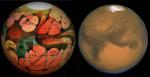 Mars Then and Now
12.11.2003
Does Mars have canals? A hot debate topic of the late 1800s, several prominent astronomers including Percival Lowell not only claimed to see an extensive system of long straight canals on Mars, but used them to indicate that intelligent life exists there.
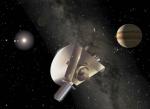 New Horizons at Jupiter
4.12.2003
Headed for the first close-up exploration of the Pluto-Charon system and the icy denizens of the Kuiper belt, NASA's New Horizons spacecraft is pictured here in an artist's vision of the robot probe outward bound.
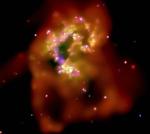 X Rays From Antennae Galaxies
3.02.2004
A bevy of black holes and neutron stars shine as bright, point-like sources against bubbles of million degree gas in this false-color x-ray image from the orbiting Chandra Observatory. The striking picture spans about...
 Fornax Cluster in Motion
24.09.2004
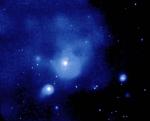
Reminiscent of popular images of the lovely Pleiades star cluster that lies within our own Milky Way Galaxy, this false-color x-ray view actually explores the center of a much more extended cosmic family -- the Fornax cluster of galaxies some 65 million light-years away.
|
January February March April May June July August September October |
|||||||||||||||||||||||||||||||||||||||||||||||||