
|
You entered: NASA
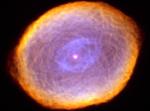 IC 418: The Spirograph Nebula
30.09.2001
What is creating the strange texture of IC 418? Dubbed the Spirograph Nebula for its resemblance to drawings from a cyclical drawing tool, planetary nebula IC 418 shows patterns that are not well understood. Perhaps they are related to chaotic winds from the variable central star, which changes brightness unpredictably in just a few hours.
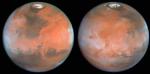 Bound For Mars
22.05.1997
Two NASA spacecraft, Mars Global Surveyor and Mars Pathfinder, are presently approaching the red planet. Pathfinder is scheduled to land on July 4th and Global Surveyor due to enter orbit in September. Recent studies...
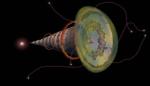 Cosmic Rays and Supernova Dust
18.06.1998
Cosmic Rays are celestial high energy particles traveling at nearly the speed of light, which constantly bombard the Earth. Discovered during high altitude balloon flights in 1912 their source has been a long standing mystery.
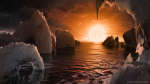 Artistic Impression: The Surface of TRAPPIST 1f
26.06.2017
If you could stand on the surface of the newly discovered Earth-sized exoplanet TRAPPIST-1f, what would you see? Presently, no Earthling knows for sure, but the featured illustration depicts a reasoned guess based on observational data taken by NASA's Sun-orbiting Spitzer Space Telescope.
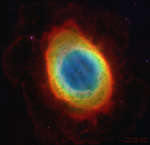 M57: The Ring Nebula from Hubble
17.08.2021
Except for the rings of Saturn, the Ring Nebula (M57) is probably the most famous celestial circle. Its classic appearance is understood to be due to our own perspective, though. The recent mapping...
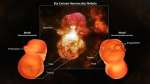 3D Homunculus Nebula
17.07.2014
If you're looking for something to print with that new 3D printer, try out a copy of the Homunculus Nebula. The dusty, bipolar cosmic cloud is around 1 light-year across but is slightly scaled down for printing to about 1/4 light-nanosecond or 80 millimeters.
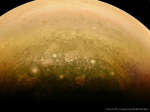 Clouds Near Jupiters South Pole from Juno
25.10.2016
What's happening near the south pole of Jupiter? Recent images sent back by NASA's robotic Juno spacecraft are showing an interesting conglomeration of swirling clouds and what appear to be white ovals.
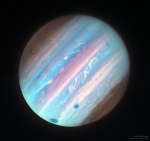 Jupiter in Ultraviolet from Hubble
16.10.2018
Jupiter looks a bit different in ultraviolet light. To better interpret Jupiter's cloud motions and to help NASA's robotic Juno spacecraft understand the planetary context of the small fields that it sees, the Hubble Space Telescope is being directed to regularly image the entire Jovian giant.
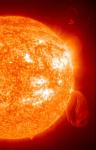 Maximum Sun
1.03.2001
Astronomers recently witnessed an astounding, large scale solar event as the Sun's north and south magnetic poles changed places! But, this complete solar magnetic field flip was actually anticipated. It occurs every 11 years during the maximum of the solar activity cycle.
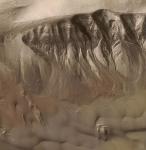 Gullies on Mars
24.10.2002
The Gullies of Mars would probably not have been sensational enough for the title of a vintage Edgar Rice Burroughs story about the Red Planet. But it would get the attention of planetary scientists today.
|
January February March April May June July August September October |
|||||||||||||||||||||||||||||||||||||||||||||||||