
|
You entered: light
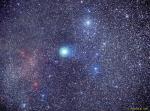 Skyscape with Comet Holmes
9.11.2007
This gorgeous skyscape spans some 10 degrees across the heroic constellation Perseus, about the size of a generous binocular field of view. The deep exposure includes bright stars, emission nebulae, star clusters, and, of course, the famous Comet Holmes. To identify the celestial landmarks, just place your cursor over the image.
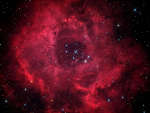 The Rosette Nebula
14.02.2012
The Rosette Nebula is not the only cosmic cloud of gas and dust to evoke the imagery of flowers -- but it is the most famous. At the edge of a large molecular cloud...
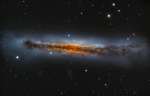 Edge on NGC 3628
20.06.2013
Sharp telescopic views of magnificent edge-on spiral galaxy NGC 3628 show a puffy galactic disk divided by dark dust lanes. Of course, this deep galactic portrait puts some astronomers in mind of its popular moniker, The Hamburger Galaxy.
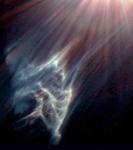 Reflecting Merope
6.12.2000
In the famous Pleiades star cluster, a star's light is slowly destroying a passing cloud of gas and dust. The star, Merope, lies just off the upper right edge of this recently released picture by the Hubble Space Telescope.
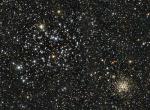 Open Star Clusters M35 and NGC 2158
29.11.2002
Open clusters of stars can be near or far, young or old, and diffuse or compact. Open clusters may contain from 100 to 10,000 stars, all of which formed at nearly the same time. Bright blue stars frequently distinguish younger open clusters.
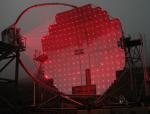 Night MAGIC
15.10.2004
Is it magic? On a rare foggy night, mysterious laser beams seem to play across the MAGIC telescope at Roque de los Muchachos on the Canary Island of La Palma. The lasers are actually part of a system designed to automatically adjust the focusing of the inovative, seventeen meter wide, multi-mirrored instrument.
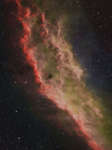 NGC 1499: The California Nebula
2.03.2011
What's California doing in space? Drifting through the Orion Arm of the spiral Milky Way Galaxy, this cosmic cloud by chance echoes the outline of California on the west coast of the United States.
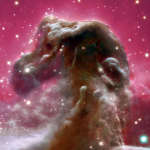 The Horsehead Nebula from Blue to Infrared
28.07.2014
One of the most identifiable nebulae in the sky, the Horsehead Nebula in Orion, is part of a large, dark, molecular cloud. Also known as Barnard 33, the unusual shape was first discovered on a photographic plate in the late 1800s.
 NGC 2736: The Pencil Nebula
15.07.2016
Moving from top to bottom in the frame near the center of this sharply detailed color composite, thin, bright, braided filaments are actually long ripples in a cosmic sheet of glowing gas seen almost edge-on. The shock wave plows through interstellar space at over 500,000 kilometers per hour.
 IFN and the NGC 7771 Group
31.08.2024
Galaxies of the NGC 7771 Group are featured in this intriguing skyscape. Some 200 million light-years distant toward the constellation Pegasus, NGC 7771 is the large, edge-on spiral near center, about 75,000 light-years across, with two smaller galaxies below it. Large spiral NGC 7769 is seen face-on to the right.
|
January February March April May June July August September October |
|||||||||||||||||||||||||||||||||||||||||||||||||