
|
You entered: light
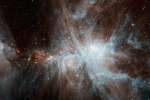 Spitzer's Orion
31.08.2019
Few cosmic vistas excite the imagination like the Orion Nebula, an immense stellar nursery some 1,500 light-years away. Spanning about 40 light-years across the region, this infrared image from the Spitzer Space Telescope...
 APOD: 2024 February 27 Б Supernova Remnant Simeis 147
27.02.2024
It's easy to get lost following the intricate, looping, and twisting filaments of supernova remnant Simeis 147. Also cataloged as Sharpless 2-240, the filamentary nebula goes by the popular nickname the Spaghetti Nebula.
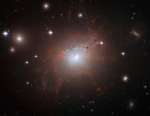 Active Galaxy NGC 1275
22.08.2008
Active galaxy NGC 1275 is the central, dominant member of the large and relatively nearby Perseus Cluster of Galaxies. A prodigious source of x-rays and radio emission, NGC 1275 accretes matter as entire galaxies fall into it, ultimately feeding a supermassive black hole at the galaxy's core.
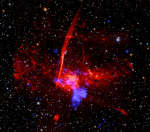 APOD: 2026 June 18 Б Possible Supernova Remnant in Galactic Center
18.06.2026
Do you see that blue blob to the lower right of the image center? Astronomers think that it shows where a massive star exploded as a supernova whose light reached Earth 1,700 years ago.
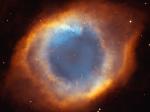 NGC 7293: The Helix Nebula
10.05.2003
Will our Sun look like this one day? The Helix Nebula is the closest example of a planetary nebula created at the end of the life of a Sun-like star. The outer gasses of the star expelled into space appear from our vantage point as if we are looking down a helix.
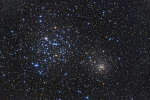 Open Star Clusters M35 and NGC 2158
3.01.2013
Open clusters of stars can be near or far, young or old, and diffuse or compact. Found near the plane of our Milky Way galaxy, they contain from 100 to 10,000 stars, all of which formed at nearly the same time. Bright blue stars frequently distinguish younger open clusters.
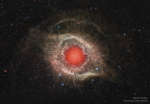 The Helix Nebula in Infrared
20.09.2016
What makes this cosmic eye look so red? Dust. The featured image from the robotic Spitzer Space Telescope shows infrared light from the well-studied Helix Nebula (NGC 7293) a mere 700 light-years away in the constellation of the Water Carrier Aquarius.
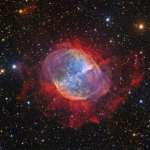 M27 Not a Comet
9.06.2017
While hunting for comets in the skies above 18th century France, astronomer Charles Messier diligently kept a list of the things he encountered that were definitely not comets. This is number 27 on his now famous not-a-comet list.
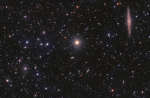 NGC 891 vs Abell 347
2.11.2017
Distant galaxies lie beyond a foreground of spiky Milky Way stars in this telescopic field of view. Centered on yellowish star HD 14771, the scene spans about 1 degree on the sky toward the northern constellation Andromeda. At top right is large spiral galaxy NGC 891, 100 thousand light-years across and seen almost exactly edge-on.
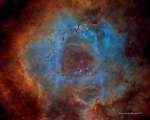 When Roses Aren t Red
22.02.2018
Not all roses are red of course, but they can still be very pretty. Likewise, the beautiful Rosette Nebula and other star forming regions are often shown in astronomical images with a predominately red hue, in part because the dominant emission in the nebula is from hydrogen atoms.
|
January February March April May June July August September October |
|||||||||||||||||||||||||||||||||||||||||||||||||