
|
You entered: light
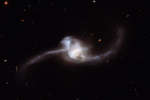 NGC 2623: Galaxy Merger from Hubble
9.11.2009
Where do stars form when galaxies collide? To help find out, astronomers imaged the nearby galaxy merger NGC 2623 in high resolution with the Hubble Space Telescope in 2007. Analysis of this Hubble image...
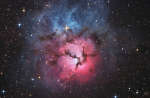 A Beautiful Trifid
20.10.2017
The beautiful Trifid Nebula is a cosmic study in contrasts. Also known as M20, it lies about 5,000 light-years away toward the nebula rich constellation Sagittarius. A star forming region in the plane...
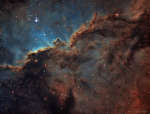 APOD: 2020 July 28 Б NGC 6188: The Dragons of Ara
28.07.2020
Dark shapes with bright edges winging their way through dusty NGC 6188 are tens of light-years long. The emission nebula is found near the edge of an otherwise dark and large molecular cloud in the southern constellation Ara, about 4,000 light-years away.
 M1: The Crab Nebula
9.11.2023
The Crab Nebula is cataloged as M1, the first object on Charles Messier's famous 18th century list of things which are not comets. In fact, the Crab is now known to be a supernova remnant, debris from the death explosion of a massive star witnessed by astronomers in the year 1054.
 APOD: 2025 May 6 Б The Doubly Warped World of Binary Black Holes
6.05.2025
If one black hole looks strange, what about two? Light rays from accretion disks around a pair of orbiting supermassive black holes make their way through the warped space-time produced by extreme gravity in this detailed computer visualization.
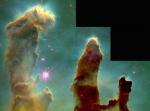 M16: Stars from Eagle's EGGs
25.11.2001
Newborn stars are forming in the Eagle Nebula. This image, taken with the Hubble Space Telescope in 1995, shows evaporating gaseous globules (EGGs) emerging from pillars of molecular hydrogen gas and dust. The giant pillars are light years in length and are so dense that interior gas contracts gravitationally to form stars.
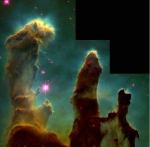 M16: Stars from Eagle's Eggs
24.09.2000
Newborn stars are forming in the Eagle Nebula. This image, taken with the Hubble Space Telescope in 1995, shows evaporating gaseous globules (EGGs) emerging from pillars of molecular hydrogen gas and dust. The giant pillars are light years in length and are so dense that
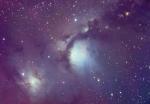 The Reflecting Dust Clouds of Orion
21.01.2003
In the vast Orion Molecular Cloud complex, several bright blue nebula are particularly apparent. Pictured above are two of the most prominent reflection nebulas -- dust clouds lit by the reflecting light of bright-embedded stars. The more famous nebula is M78, on the upper right, cataloged over 200 years ago.
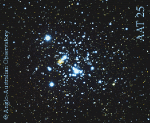 NGC 4755: A Jewel Box of Stars
11.11.1996
The great variety of star colors in this open cluster underlie it's name: The Jewel Box. The bright central star Kappa Crucis is red, in contrast to the many blue stars that surround it. The cluster contains just over 100 stars, and might be no older than 10 million years.
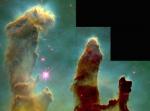 M16: Stars from Eagles EGGs
26.10.2003
Newborn stars are forming in the Eagle Nebula. This image, taken with the Hubble Space Telescope in 1995, shows evaporating gaseous globules (EGGs) emerging from pillars of molecular hydrogen gas and dust. The giant pillars are light years in length and are so dense that interior gas contracts gravitationally to form stars.
|
January February March April May June July August September October |
|||||||||||||||||||||||||||||||||||||||||||||||||