
|
You entered: light
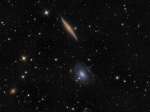 NGC 5965 and NGC 5963 in Draco
16.02.2012
These two spiral galaxies make a photogenic pair, found within the boundaries of the northern constellation Draco. Contrasting in color and orientation, NGC 5965 is nearly edge-on to our line of sight and dominated by yellow hues, while bluish NGC 5963 is closer to face-on.
 The Swirling Core of the Crab Nebula
8.07.2016
At the core of the Crab Nebula lies a city-sized, magnetized neutron star spinning 30 times a second. Known as the Crab Pulsar, it's actually the rightmost of two bright stars, just below a central swirl in this stunning Hubble snapshot of the nebula's core.
 Distortion from a Distant Cluster
23.08.2001
This stunning color deep sky view toward the constellation Pisces was made with data from a fast, sensitive, digital detector known as the Big Throughput Camera operating at Cerro Tololo Inter-American Observatory in Chile.
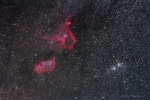 Heart and Soul and Double Cluster
24.09.2016
This rich starfield spans almost 10 degrees across the sky toward the northern constellations Cassiopeia and Perseus. On the left, heart-shaped cosmic cloud IC 1805 and IC 1848 are popularly known as the Heart and Soul nebulae.
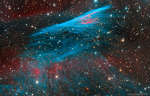 The Pencil Nebula in Red and Blue
13.08.2018
This shock wave plows through interstellar space at over 500,000 kilometers per hour. Near the top and moving up in this sharply detailed color composite, thin, bright, braided filaments are actually long ripples in a cosmic sheet of glowing gas seen almost edge-on.
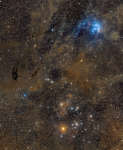 Pleiades to Hyades
6.12.2019
This cosmic vista stretches almost 20 degrees from top to bottom, across the dusty constellation Taurus. It begins at the Pleiades and ends at the Hyades, two star clusters recognized since antiquity in Earth's night sky. At top, the compact Pleiades star cluster is about 400 light-years away.
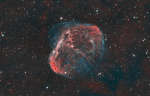 NGC 6888: The Crescent Nebula
17.06.2021
NGC 6888, also known as the Crescent Nebula, is a about 25 light-years across blown by winds from its central, bright, massive star. A triumvirate of astroimagers ( Joe, Glenn, Russell) created this sharp portrait of the cosmic bubble.
 APOD: 2025 March 5 Б Seven Sisters versus California
5.03.2025
On the right, dressed in blue, is the Pleiades. Also known as the Seven Sisters and M45, the Pleiades is one of the brightest and most easily visible open clusters on the sky. The Pleiades contains over 3,000 stars, is about 400 light years away, and only 13 light years across.
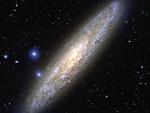 Spiral Galaxy NGC 253 Almost Sideways
25.05.2003
NGC 253 is a normal spiral galaxy seen here almost sideways. It is the largest member of the Sculptor Group of Galaxies, the nearest group to our own Local Group of Galaxies.
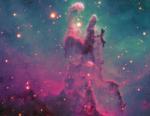 Eagle Castle
30.07.1997
What lights up this castle of star formation? The familiar Eagle Nebula glows much like a neon sign, but in many colors at once. The above photograph is a composite of three of these glowing gas colors.
|
January February March April May June July August September October |
|||||||||||||||||||||||||||||||||||||||||||||||||