
|
You entered: light
 A Martian Lake Bed
10.12.1997
Look closely. In this Mars Global Surveyor image of the Martian surface just south of Schiaparelli crater, dark lines appear to criss-cross light colored depressions. One tantalizing possibility is simply that the feature near...
 A Distant Destiny
13.01.1998
Watching galaxies recede, observational astronomers of the 20th century discovered an astounding fact - the Universe is expanding. Will it continue to expand forever? The speed of light is finite so looking into the distant Universe is equivalent to looking at the distant past.
 Dust of the Orion Nebula
6.02.2012
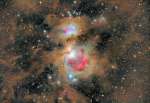
What surrounds a hotbed of star formation? In the case of the Orion Nebula -- dust. The entire Orion field, located about 1600 light years away, is inundated with intricate and picturesque filaments of dust.
 The Pillars of Eagle Castle
14.07.2013
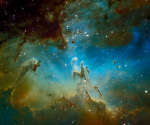
What lights up this castle of star formation? The familiar Eagle Nebula glows bright in many colors at once. The above image is a composite of three of these glowing gas colors. Pillars of dark dust nicely outline some of the denser towers of star formation.
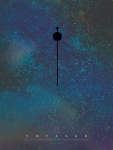 Milky Way Voyager
1.09.2017
Launched in 1977 on a tour of the outer planets of the Solar System, Voyager 1 and 2 have become the longest operating and most distant spacecraft from Earth. Nearly 16 light-hours from...
 APOD: 2023 April 10 Б IC 2944: The Running Chicken Nebula
9.04.2023
To some, it looks like a giant chicken running across the sky. To others, it looks like a gaseous nebula where star formation takes place. Cataloged as IC 2944, the Running Chicken Nebula spans about 100 light years and lies about 6,000 light years away toward the constellation of the Centaur (Centaurus).
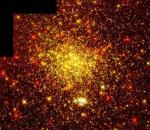 NGC1850: Star Cluster in the LMC
29.07.2000
NGC1850 is a large cluster of stars located a mere 166,000 light-years from Earth in our neighboring galaxy the Large Magellanic Cloud (LMC). The colors in this beautiful Hubble Space Telescope composite image of the cluster reveal different populations of stars.
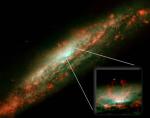 The Bubbling Cauldron of NGC 3079
22.08.2001
Edge-on spiral galaxy NGC 3079 is a mere 50 million light-years away toward the constellation Ursa Major. Shown in this stunning false-color Hubble Space Telescope image, the galaxy's disk - composed of spectacular star clusters in winding spiral arms and dramatic dark lanes of dust - spans some 70,000 light-years.
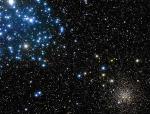 Open Star Clusters M35 and NGC 2158
14.12.2003
Open clusters of stars can be near or far, young or old, and diffuse or compact. Open clusters may contain from 100 to 10,000 stars, all of which formed at nearly the same time. Bright blue stars frequently distinguish younger open clusters.
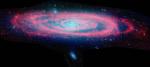 Infrared Andromeda
21.07.2007
This wide, detailed Spitzer Space Telescope view features infrared light from dust (red) and old stars (blue) in Andromeda, a massive spiral galaxy a mere 2.5 million light-years away. In fact, with over twice the diameter of our own Milky Way, Andromeda is the largest nearby galaxy.
|
January February March April May June July August September October |
|||||||||||||||||||||||||||||||||||||||||||||||||