
|
You entered: light
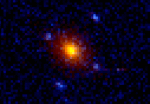 A Galaxy Gravitational Lens
20.12.1995
Sometimes it takes a keen eye to see a good mirage. Around the center of the red galaxy image in the above photograph lie four blue "smudges." Each smudge is actually a different image of the same background quasar. The central galaxy happens to fall directly in the light path of the quasar.
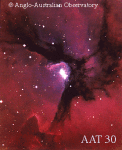 Hot Stars in the Trifid Nebula
21.12.1995
In the center of the glowing red gas on the Trifid Nebula lies an open cluster of young hot stars. The energetic light from these stars strikes hydrogen atoms in the surrounding nebula causing them to lose their electrons.
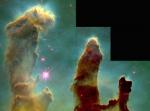 M16: Stars from Eagle's EGGs
24.04.2005
Newborn stars are forming in the Eagle Nebula. This image, taken with the Hubble Space Telescope in 1995, shows evaporating gaseous globules (EGGs) emerging from pillars of molecular hydrogen gas and dust. The giant pillars are light years in length and are so dense that interior gas contracts gravitationally to form stars.
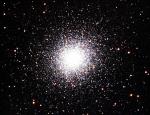 M13: The Great Globular Cluster in Hercules
1.03.2000
M13 is one of the most prominent and best known globular clusters. Visible with binoculars in the constellation of Hercules, M13 is frequently one of the first objects found by curious sky gazers seeking celestials wonders beyond normal human vision.
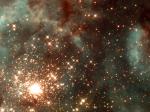 Star Cluster R136 Bursts Out
6.05.2007
In the center of star-forming region 30 Doradus lies a huge cluster of the largest, hottest, most massive stars known. These stars, known as the star cluster R136, and part of the surrounding nebula are captured here in this gorgeous visible-light image from the Hubble Space Telescope.
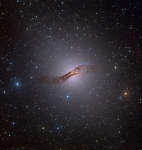 Centaurus A
17.03.2022
A mere 11 million light-years away, Centaurus A is the closest active galaxy to planet Earth. Spanning over 60,000 light-years, the peculiar elliptical galaxy also known as NGC 5128, is featured in this sharp telescopic view.
 APOD: 2024 March 27 Б The Coma Cluster of Galaxies
27.03.2024
Almost every object in the featured photograph is a galaxy. The Coma Cluster of Galaxies pictured here is one of the densest clusters known - it contains thousands of galaxies. Each of these galaxies houses billions of stars - just as our own Milky Way Galaxy does.
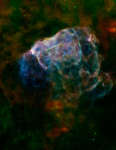 Supernova Remnant Puppis A
12.09.2014
Driven by the explosion of a massive star, supernova remnant Puppis A is blasting into the surrounding interstellar medium about 7,000 light-years away. At that distance, this remarkable false-color exploration of its complex expansion is about 180 light-years wide.
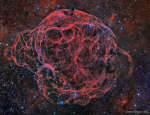 Simeis 147: Supernova Remnant
18.05.2017
It's easy to get lost following intricate filaments in this detailed image of faint supernova remnant Simeis 147. Also cataloged as Sharpless 2-240 it goes by the popular nickname, the Spaghetti Nebula. Seen toward the boundary of the constellations Taurus and Auriga, it covers nearly 3 degrees or 6 full moons on the sky.
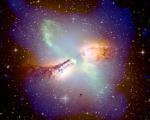 The Colors and Mysteries of Centaurus A
12.08.2002
Why is spiral galaxy Centaurus A in so much turmoil? The above composite image shows different clues to the unusual galaxy's past in different bands of light. In low energy radio waves, shown in red, lobes across the thick swath of dust glow brightly.
|
January February March April May June July August September October |
|||||||||||||||||||||||||||||||||||||||||||||||||