
|
You entered: light
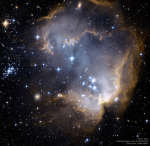 APOD: 2026 April 13 Б NGC 602 and Beyond
13.04.2026
The clouds may look like an oyster, and the stars like pearls, but look beyond. Near the outskirts of the Small Magellanic Cloud, a satellite galaxy some 200 thousand light-years distant, lies 5 million year young star cluster NGC 602.
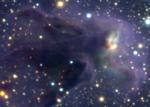 M16: Infrared Star Hunt
4.01.2002
The head of an interstellar gas and dust cloud is shown here in false-color, a near-infrared view recorded by astronomers hunting for stars within M16's Eagle Nebula. Made famous in a 1995 Hubble...
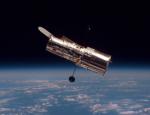 Hubble Floats Free
6.03.1997
Why put observatories in space? Most telescopes are on the ground. On the ground, you can deploy a heavier telescope and upgrade it more easily. The trouble is that Earth-bound telescopes must look through the Earth's atmosphere.
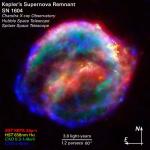 Kepler s SNR from Chandra, Hubble, Spitzer
8.10.2004
Light from the stellar explosion that created this energized cosmic cloud was first seen on planet Earth in October 1604, a mere four hundred years ago. The supernova produced a bright new star in early 17th century skies within the constellation Ophiucus.
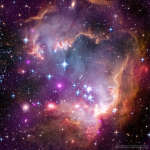 NGC 602 and Beyond
2.04.2017
Near the outskirts of the Small Magellanic Cloud, a satellite galaxy some 200 thousand light-years distant, lies 5 million year young star cluster NGC 602. Surrounded by natal gas and dust...
 APOD: 2025 March 12 Б NGC 772: The Fiddlehead Galaxy
12.03.2025
Why does this galaxy look like a curly vegetable? The Fiddlehead spiral galaxy likely gets its distorted spiral appearance from a gravitational interaction with its close-by elliptical companion NGC 770, seen just below. Cataloged...
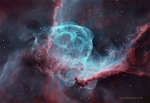 APOD: 2026 June 9 Б Thors Helmet
9.06.2026
Thor not only has his own day (Thursday), but a helmet in the heavens. Popularly called Thor's Helmet, NGC 2359 is a hat-shaped cosmic cloud with wing-like appendages. Heroically sized even for a Norse god, Thor's Helmet is about 30 light-years across.
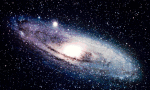 M31: The Andromeda Galaxy
9.10.1996
Andromeda is the nearest major galaxy to our own Milky Way Galaxy. Our Galaxy is thought to look much like Andromeda. Together these two galaxies dominate the Local Group of galaxies. The diffuse light from Andromeda is caused by the hundreds of billions of stars that compose it.
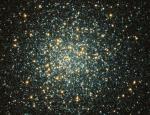 Globular Cluster M3
15.09.2003
This huge ball of stars predates our Sun. Long before humankind evolved, before dinosaurs roamed, and even before our Earth existed, ancient globs of stars condensed and orbited a young Milky Way Galaxy.
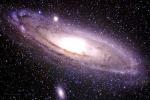 M31: The Andromeda Galaxy
14.11.1999
Andromeda is the nearest major galaxy to our own Milky Way Galaxy. Our Galaxy is thought to look much like Andromeda. Together these two galaxies dominate the Local Group of galaxies. The diffuse light from Andromeda is caused by the hundreds of billions of stars that compose it.
|
January February March April May June July August September October |
|||||||||||||||||||||||||||||||||||||||||||||||||