
|
You entered: cluster
 APOD: 2026 March 29 Б A Message from Earth
29.03.2026
What are these Earthlings trying to tell us? The featured message was broadcast from Earth towards the globular star cluster M13 in 1974. During the dedication of an upgrade to the Arecibo Observatory - then the largest single radio telescope in the world - a string of 1's and 0's representing the diagram was sent.
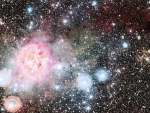 The Cocoon Nebula from CFHT
14.01.2008
What creates the colors of the Cocoon Nebula? The Cocoon Nebula, cataloged as IC 5146, is a strikingly beautiful nebula located about 4,000 light years away toward the constellation of the Swan (Cygnus). Inside the Cocoon Nebula is a newly developing open cluster of stars.
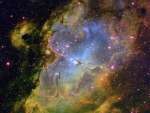 Inside the Eagle Nebula
8.02.2009
From afar, the whole thing looks like an Eagle. A closer look at the Eagle Nebula, however, shows the bright region is actually a window into the center of a larger dark shell of dust. Through this window, a brightly-lit workshop appears where a whole open cluster of stars is being formed.
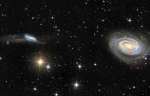 Arp 159 and NGC 4725
3.09.2015
Pointy stars and peculiar galaxies span this cosmic snapshot, a telescopic view toward the well-groomed constellation Coma Berenices. Bright enough to show off diffraction spikes, the stars are in the foreground of the scene, well within our own Milky Way. But the two prominent galaxies lie far beyond our own, some 41 million light-years distant.
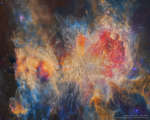 The Orion Nebula in Infrared from WISE
2.01.2019
The Great Nebula in Orion is an intriguing place. Visible to the unaided eye, it appears as a small fuzzy patch in the constellation of Orion. But this image, an illusory-color four-panel mosaic taken...
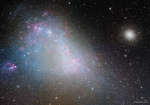 The Small Cloud of Magellan
5.01.2021
What is the Small Magellanic Cloud? It has turned out to be a galaxy. People who have wondered about this little fuzzy patch in the southern sky included Portuguese navigator Ferdinand Magellan...
 APOD: 2024 October 21 Б Comet Tsuchinshan ATLAS over California
21.10.2024
The tails of Comet Tsuchinshan-ATLAS were a sight to behold. Pictured, C/2023 A3 (TsuchinshanБATLAS) was captured near peak impressiveness last week over the Eastern Sierra Mountains in California, USA. The comet not only showed a bright tail, but a distinct anti-tail pointing in nearly the opposite direction.
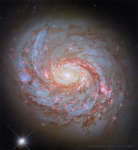 APOD: 2025 December 2 Б M77: Spiral Galaxy with an Active Center
2.12.2025
What's happening in the center of nearby spiral galaxy M77? The face-on galaxy lies a mere 47 million light-years away toward the constellation of the Sea Monster (Cetus). At that estimated distance, this gorgeous island universe is about 100 thousand light-years across.
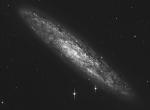 Spiral Galaxy NGC 253
21.01.1999
A camera with over 67 million pixels (digital picture elements) was used to record this stunning image of spiral galaxy NGC 253. Known as the Wide Field Imager (WFI), the camera is the latest instrument to be installed at the European Southern Observatory's 2.2 meter telescope in La Silla, Chile.
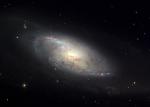 M106 in Canes Venatici
30.07.2005
Close to the Great Bear (Ursa Major) and surrounded by the stars of the Hunting Dogs (Canes Venatici), this celestial nebula was discovered in 1781 by the metric French astronomer Pierre Mechain. Later, it was added to the catalog of his friend and colleague Charles Messier as M106.
|
January February March April May June July August September October |
|||||||||||||||||||||||||||||||||||||||||||||||||