
|
You entered: cluster
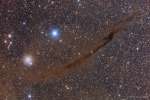 NGC 4372 and the Dark Doodad
31.01.2013
The delightful Dark Doodad Nebula drifts through southern skies, a tantalizing target for binoculars in the constellation Musca, The Fly. The dusty cosmic cloud is seen against rich starfields just south of the prominent Coalsack Nebula and the Southern Cross.
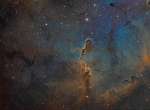 The Elephant s Trunk in IC 1396
26.07.2013
Like an illustration in a galactic Just So Story, the Elephant's Trunk Nebula winds through the emission nebula and young star cluster complex IC 1396, in the high and far off constellation of Cepheus. Of course, the cosmic elephant's trunk is over 20 light-years long.
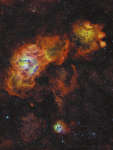 Sagittarius Sunflowers
23.06.2016
These three bright nebulae are often featured in telescopic tours of the constellation Sagittarius and the crowded starfields of the central Milky Way. In fact, 18th century cosmic tourist Charles Messier cataloged...
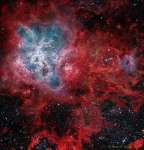 The Cosmic Web of the Tarantula Nebula
7.11.2016
It is the largest and most complex star forming region in the entire galactic neighborhood. Located in the Large Magellanic Cloud, a small satellite galaxy orbiting our Milky Way galaxy, the region's spidery appearance is responsible for its popular name, the Tarantula nebula. This tarantula, however, is about 1,000 light-years across.
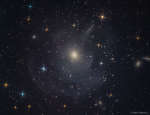 M89: Elliptical Galaxy with Outer Shells and Plumes
13.06.2017
Can you see them? This famous Messier object M89, a seemingly simple elliptical galaxy, is surrounded by faint shells and plumes. The cause of the shells is currently unknown, but possibly tidal tails related to debris left over from absorbing numerous small galaxies in the past billion years.
 APOD: 2023 May 15 Б M16: Eagle Nebula Deep Field
14.05.2023
From afar, the whole thing looks like an eagle. A closer look at the Eagle Nebula, however, shows the bright region is actually a window into the center of a larger dark shell of dust. Through this window, a brightly-lit workshop appears where a whole open cluster of stars is being formed.
 Facing NGC 1232
17.04.2024
From our vantage point in the Milky Way Galaxy, we see NGC 1232 face-on. Nearly 200,000 light-years across, the big, beautiful spiral galaxy is located some 47 million light-years away in the flowing southern constellation of Eridanus. This sharp, multi-color, telescopic image of NGC 1232 includes remarkable details of the distant island universe.
 A Message From Earth
12.03.2005
What are these Earthlings trying to tell us? The above message was broadcast from Earth towards the globular star cluster M13 in 1974. During the dedication of the Arecibo Observatory - still the largest radio telescope in the world - a string of 1's and 0's representing the above diagram was sent.
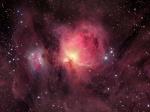 M42: Wisps of the Orion Nebula
18.09.2005
The Great Nebula in Orion, an immense, nearby starbirth region, is probably the most famous of all astronomical nebulas. Here, glowing gas surrounds hot young stars at the edge of an immense interstellar molecular cloud only 1500 light-years away. In the above deep image, faint wisps and sheets of dust and gas are particularly evident.
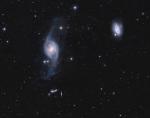 Extra Galaxies
31.08.2006
Careful inspection of the full field of view for this sharp composite image reveals a surprising number of galaxies both near and far toward the constellation Ursa Major. The most striking is clearly NGC 3718, a warped spiral galaxy found near picture center.
|
January February March April May June July August September October |
|||||||||||||||||||||||||||||||||||||||||||||||||