
|
You entered: cluster
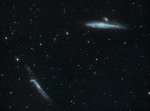 The Whale and the Hockey Stick
21.08.2009
NGC 4631 is a big beautiful spiral galaxy seen edge-on (top right) only 25 million light-years away towards the small northern constellation Canes Venatici. This galaxy's slightly distorted wedge shape suggests to some a cosmic herring and to others the popular moniker of The Whale Galaxy.
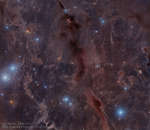 Dark Nebulas across Taurus
14.03.2016
Sometimes even the dark dust of interstellar space has a serene beauty. One such place occurs toward the constellation of Taurus. The filaments featured here can be found on the sky between the Pleiades star cluster and the California Nebula.
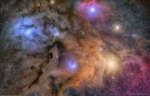 The Colorful Clouds of Rho Ophiuchi
5.07.2016
The many spectacular colors of the Rho Ophiuchi (oh'-fee-yu-kee) clouds highlight the many processes that occur there. The blue regions shine primarily by reflected light. Blue light from the star Rho Ophiuchi and nearby stars reflects more efficiently off this portion of the nebula than red light.
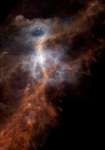 Herschel s Orion
14.10.2016
This dramatic image peers within M42, the Orion Nebula, the closest large star-forming region. Using data at infrared wavelengths from the Herschel Space Observatory, the false-color composite explores the natal cosmic cloud a mere 1,500 light-years distant.
 An Elephant s Trunk in Cepheus
16.01.2018
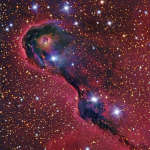
With image data from telescopes large and small, this close-up features the dusty Elephant's Trunk Nebula. It winds through the emission nebula and young star cluster complex IC 1396, in the high and far off constellation of Cepheus. Also known as vdB 142, the cosmic elephant's trunk is over 20 light-years long.
 Most of Comet Tsuchinshan ATLAS
18.10.2024
On October 14 it was hard to capture a full view of Comet C/2023 A3 Tsuchinshan-ATLAS. Taken after the comet's closest approach to our fair planet, this evening skyview almost does though. With...
 APOD: 2025 August 10 Б Zodiacal Road
10.08.2025
What's that strange light down the road? Dust orbiting the Sun. At certain times of the year, a band of sun-reflecting dust from the inner Solar System appears prominently just after sunset -- or just before sunrise -- and is called zodiacal light.
 APOD: 2026 August 30 Б M74: A Grand Design Spiral
30.08.2026
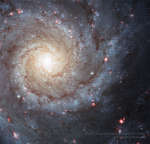
If not the most grand, then this spiral galaxy is at least one of the most photogenic. An island universe of about 100 billion stars, 32 million light-years away toward the constellation Pisces, M74 presents a gorgeous face-on view.
 The Secret Spiral Of IC3328
2.06.2000
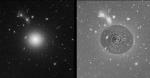
IC3328 is an otherwise unremarkable dwarf elliptical galaxy about 50 million light-years away in the Virgo cluster. But hidden within IC3328 is a subtle, beautifully symmetric spiral structure! A team of astronomers recently made this totally surprising discovery using detailed digital images from the European Southern Observatory's 8.2 meter Antu telescope.
 Portrait of an Infant Solar System
7.06.2002
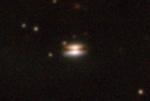
This infant solar system was discovered posing along the lonely outskirts of the Rho Ophiuchi dark cloud, a star forming region 500 light-years from Earth. Enlarged in this infrared false-color portrait from the European...
|
January February March April May June July August September October |
|||||||||||||||||||||||||||||||||||||||||||||||||