
|
You entered: rings
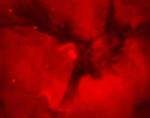 Hydrogen Trifid
28.08.1998
Clouds of glowing hydrogen gas mingle with dark dust lanes in the Trifid Nebula, a star forming region in the constellation Sagittarius. In this and other similar emission nebulae, energetic ultraviolet light from an embedded hot young star strips electrons from the surrounding hydrogen atoms.
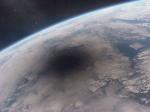 Looking Back at an Eclipsed Earth
10.06.2007
Here is what the Earth looks like during a solar eclipse. The shadow of the Moon can be seen darkening part of Earth. This shadow moved across the Earth at nearly 2000 kilometers per hour.
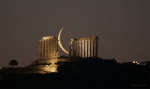 APOD: 2023 February 28 Б Crescent Moon Beyond Greek Temple
28.02.2023
Why is a thin crescent moon never seen far from a horizon? Because the only geometry that gives a thin crescent lunar phase occurs when the Moon appears close to the Sun in the sky.
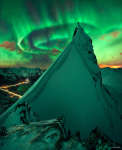 APOD: 2026 February 10 Б In Green Company: Aurora over Norway
10.02.2026
Raise your arms if you see an aurora. With those instructions, two nights went by with, well, clouds -- mostly. On the third night of returning to same peaks, though, the sky not only cleared up but lit up with a spectacular auroral display.
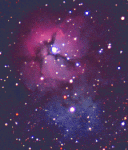 M20: The Trifid Nebula
23.07.1995
The vivid blue and violet colors present in the Trifid Nebula result from the abundance of young stars there. The light from young massive stars is quite blue and has the ability to remove electrons from surrounding gas. When these electrons re-combine with the gas, radiation rich in blue and violet light is emitted.
 Mars Rocks, Sojourner Rolls
14.08.1997
This sharp color image featuring Mars rock Yogi and the rolling Sojourner robot shows off Yogi's startling two-toned surface. Yogi appears to be leaning into the prevailing winds causing some to suggest that its color contrast may be caused by the accumulation of rust colored dust on its windward face.
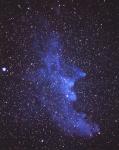 The Witch Head Nebula
9.02.1998
Double, double toil and trouble; Fire burn, and cauldron bubble ... Maybe Macbeth should have consulted the Witch Head Nebula. This suggestively shaped reflection nebula is associated with the bright star Rigel in the constellation Orion. More formally known as IC 2118, the Witch Head Nebula glows primarily by light reflected from Rigel.
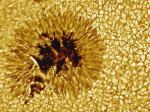 A Sunspot Up Close
6.11.2005
Why would a small part of the Sun appear slightly dark? Visible above is a close-up picture of a sunspot, a depression on the Sun's face that is slightly cooler and less luminous than the rest of the Sun.
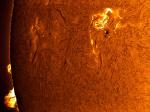 Sunspot 875 Flares
2.05.2006
An unusually active sunspot region is now crossing the Sun. The region, numbered 875, is larger than the Earth and has produced several solar flares over the past week. It should take a few more days for Sunspot 875 to finish crossing the solar disk.
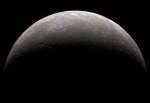 Crescent Mercury in Color
26.01.2008
Hard to spot against the twilight glow near planet Earth's horizon, a crescent Mercury was imaged close up by the MESSENGER spacecraft early last week. Colors in this remarkable picture were created using data recorded through infrared, red, and violet filters.
|
January February March April May June July August September October |
|||||||||||||||||||||||||||||||||||||||||||||||||