
|
You entered: rings
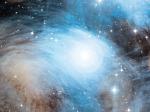 The Merope Reflection Nebula
11.06.2007
Reflection nebulas reflect light from a nearby star. Many small carbon grains in the nebula reflect the light. The blue color typical of reflection nebula is caused by blue light being more efficiently scattered by the carbon dust than red light.
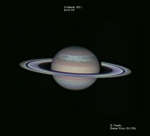 Saturn s Serpent Storm
17.03.2011
Late last year, a new, remarkably bright storm erupted in Saturn's northern hemisphere. Nicknamed "the Serpent Storm", the northern hemisphere disturbance is still going strong and now circles far around the planet. Offering...
 APOD: 2023 July 10 Б Stars, Dust and Nebula in NGC 6559
10.07.2023
When stars form, pandemonium reigns. A textbook case is the star forming region NGC 6559. Visible in the featured image are red glowing emission nebulas of hydrogen, blue reflection nebulas of dust, dark absorption nebulas of dust, and the stars that formed from them.
 The Deep Lagoon
28.09.2023
Ridges of glowing interstellar gas and dark dust clouds inhabit the turbulent, cosmic depths of the Lagoon Nebula. Also known as M8, The bright star forming region is about 5,000 light-years distant. It makes for a popular stop on telescopic tours of the constellation Sagittarius toward the center of our Milky Way Galaxy.
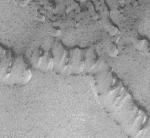 The Dunes Of Mars
14.08.1998
The North Pole of Mars is ringed by a "sea of sand dunes". For Mars' Northern Hemisphere, Spring began in mid July and increased sunlight is now shrinking the polar cap revealing the wind-swept dunes to the cameras onboard the Mars Global Surveyor spacecraft.
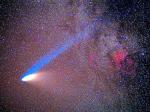 Comet Hale Bopp and the North America Nebula
3.10.2004
Comet Hale-Bopp's 1997 encounter with the inner Solar System allowed many breath-taking pictures. Above, Comet Hale-Bopp was photographed crossing the constellation of Cygnus, sporting spectacular yellow dust and blue ion tails. Visible on the right in red is the North America Nebula, a bright emission nebula observable from a dark location with binoculars.
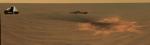 Heat Shield Impact Crater on Mars
9.02.2005
Broken metal and scorched Mars make the impact site of Opportunity's heat shield one of the more interesting sites inspected by the rolling robot. Visible on the image left is the conical outer hull of the shattered heat shield expelled by Opportunity as it plummeted toward Mars last year.
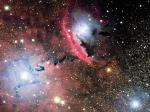 Stars, Dust and Nebula in NGC 6559
9.05.2005
When stars form, pandemonium reigns. A textbook case is the star forming region NGC 6559. Visible above are red glowing emission nebulas of hydrogen, blue reflection nebulas of dust, dark absorption nebulas of dust, and the stars that formed from them.
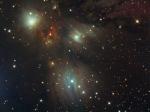 Still Life with NGC 2170
5.08.2006
In this beautiful celestial still life composed with a cosmic brush, dusty nebula NGC 2170 shines at the upper left. Reflecting the light of nearby hot stars, NGC 2170 is joined by other bluish reflection nebulae and a compact red emission region against a backdrop of stars.
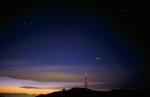 An Iridium Flash Sunset
2.05.2000
Did you see that flash? Lasting only about 15 seconds, it's possible that nobody you ask can confirm it, but what you might have seen is sunlight reflecting off an orbiting Iridium satellite. Satellites of all types have been providing streaks and glints visible only since the launch of Sputnik I in 1957.
|
January February March April May June July August September October |
|||||||||||||||||||||||||||||||||||||||||||||||||