
|
You entered: rings
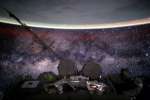 Earth and Milky Way from Space
7.11.2015
Since November 2000, people have been living continuously on the International Space Station. To celebrate humanity's 15th anniversary off planet Earth, consider this snapshot from space of our galaxy and our home world posing together beyond the orbital outpost.
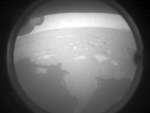 Mars Perseverance Sol 0
19.02.2021
After a 203 day interplanetary voyage, and seven minutes of terror, Perseverance has landed on Mars. Confirmation of the successful landing at Jezero crater was announced from mission control at NASAБs Jet Propulsion Laboratory in Southern California at 12:55 pm PST on February 18.
 APOD: 2024 July 29 Б Milky Way over Uluru
29.07.2024
What's happening above Uluru? A United Nations World Heritage Site, Uluru is an extraordinary 350-meter high mountain in central Australia that rises sharply from nearly flat surroundings. Composed of sandstone, Uluru has slowly formed over the past 300 million years as softer rock eroded away.
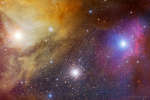 Antares and Clouds
17.04.2012
Antares is a huge star. In a class called red supergiant, Antares is about 850 times the diameter of our own Sun, 15 times more massive, and 10,000 times brighter. Antares is the brightest star in the constellation of Scorpius and one of the brighter stars in all the night sky.
 Martian Chiaroscuro
14.04.2018
Deep shadows create dramatic contrasts between light and dark in this high-resolution close-up of the martian surface. Recorded on January 24, 2014 by the HiRISE camera onboard the Mars Reconnaissance Orbiter, the scene spans about 1.5 kilometers.
 The Orion Nebula in Hydrogen
22.11.2000
The Great Nebula in Orion can be found just below and to the left of the easily identifiable belt of three stars in the popular constellation Orion. This fuzzy patch, visible to the unaided eye, contains one of the closest stellar nurseries, lying at a distance of about 1500 light years.
 NASA's Latest Rockets: X-33
2.07.1996
What will NASA rockets look like in the future? Today's announcement gave one indication. Today Vice- President Al Gore announced that the Lockheed Martin Corporation will work with NASA to produce a reusable rocket with a remote pilot.
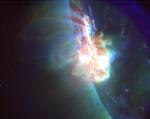 An Active Region of the Sun
16.06.1998
The Sun is a busy place. This false-color image depicts an active region near an edge of the Sun. Hot plasma is seen exploding off the Sun's photosphere and traveling along loops defined by the Sun's magnetic field.
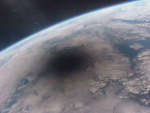 Looking Back at an Eclipsed Earth
2.01.2011
Here is what the Earth looks like during a solar eclipse. The shadow of the Moon can be seen darkening part of Earth. This shadow moved across the Earth at nearly 2000 kilometers per hour.
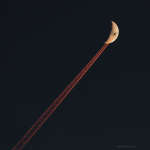 Plane Crossing a Crescent Moon
12.02.2019
No, this is not a good way to get to the Moon. What is pictured is a chance superposition of an airplane and the Moon. The contrail would normally appear white, but the large volume of air toward the setting Sun preferentially knocks away blue light, giving the reflected trail a bright red hue.
|
January February March April May June July August September October |
|||||||||||||||||||||||||||||||||||||||||||||||||