
|
You entered: rings
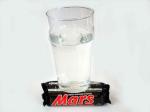 Water on Mars
1.04.2005
Can you help discover water on Mars? Finding water on different regions on Mars has implications for understanding its complex geologic history, the possible existence of past life and the sustenance of potential future astronauts.
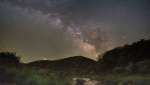 Countryside Mars and Milky Way
9.06.2018
Mars shines brightly now in planet Earth's sky. Seen with a yellowish hue it rises over the hills and far away in this serene night skyscape, a countryside panorama recorded last month from Parque Nacional de Cabaneros in Spain. The Milky Way too extends above the distant hills into a starry sky.
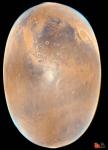 A Mars Glint
8.06.1998
If aligned just right, even a planet can produce a glint. The above combined pictures of Mars make the red planet appear unusually elongated - Mars is really almost spherical. However, these pictures were taken when the Sun was nearly directly behind the Mars Global Surveyor (MGS) spacecraft.
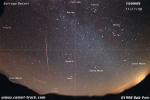 An Annotated Leonid
11.11.2001
The 1998 Leonids Meteor Shower was one of the most photographed meteor event in history. Patient observers saw bright meteors streak across dark skies every few minutes, frequently leaving fading trails stretching across the sky. High above the Anza-Borrego Desert, a meteor was photographed streaking up from the radiant constellation of the Leonids: Leo.
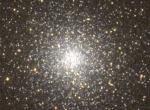 Globular Cluster 47 Tucanae
19.09.1997
Stars come in bunches. Of the over 200 globular star clusters that orbit the center of our Milky Way Galaxy, 47 Tucanae is the second brightest globular cluster (behind Omega Centauri). Known to some affectionately as 47 Tuc or NGC 104, it is only visible from the Southern Hemisphere.
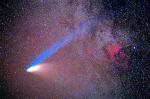 Hale Bopp and the North American Nebula
9.10.1997
Comet Hale-Bopp's recent encounter with the inner Solar System allowed many breath-taking pictures. Above, Comet Hale-Bopp was photographed on March 8th in the constellation of Cygnus. Visible on the right in red is the North American Nebula, a bright emission nebula observable from a dark location with binoculars.
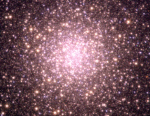 Globular Cluster M3
19.07.1998
This huge ball of stars predates our Sun. Long before mankind evolved, before dinosaurs roamed, and even before our Earth existed, ancient globs of stars condensed and orbited a young Milky Way Galaxy.
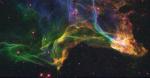 The Cygnus Loop
23.06.2001
The shockwave from a 20,000 year-old supernova in the constellation of Cygnus supernova explosion is still expanding into interstellar space. The collision of this fast moving wall of gas with a stationary cloud...
 Catching Falling Stardust
17.11.2001
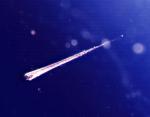
This carrot-shaped track is actually little more than 5 hundredths of an inch long. It is the trail of a meteroid through the high-tech substance aerogel exposed to space by the shuttle launched EURECA (European Recoverable Carrier) spacecraft.
 Mars Climate Orbiter Launches
24.12.1998
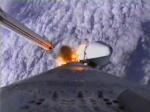
Looking down from atop a Delta II rocket blasting skyward, solid fuel boosters fall away (left) and the Earth's limb slides into view. These pictures from the launch of the Mars Climate Orbiter were taken as it climbed away from Cape Canaveral Air Station Space Launch Complex 17 on December 11.
|
January February March April May June July August September October |
|||||||||||||||||||||||||||||||||||||||||||||||||