
|
You entered: rings
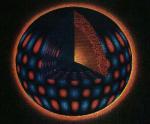 The Sun Oscillates
15.06.1999
Our Sun is in a continual state of oscillation. Large patches of the Sun vibrate in and out, back and forth, even as the Sun rotates. One mode of Solar oscillation is depicted graphically above, with blue indicating outward motion, and red indicating inward motion.
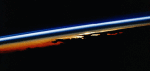 The Sun Also Rises
17.11.1995
Sunrise seen from low Earth orbit by the shuttle astronauts can be very dramatic indeed (and the authors apologize to Hemingway for using his title!). In this breathtaking view, the Sun is just visible...
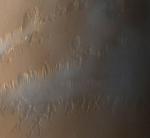 Mars: A Mist In Mariner Valley
17.10.1997
An icy mist and late afternoon clouds cover much of this section of Valles Marineris on Mars. The Valles Marineris or Mariner Valley is a huge canyon system about 2,000 miles long and up to 5 miles deep.
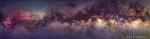 A Milky Way Band
24.02.1999
Most bright stars in our Milky Way Galaxy reside in a disk. Since our Sun also resides in this disk, these stars appear to us as a diffuse band that circles the sky. The above panorama of a southern band of the Milky Way's disk was taken from Australia.
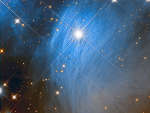 Meropes Reflection Nebula
15.02.2012
Reflection nebulas reflect light from a nearby star. Many small carbon grains in the nebula reflect the light. The blue color typical of reflection nebula is caused by blue light being more efficiently scattered by the carbon dust than red light.
 Strawberry Sun
29.08.2013
This striking, otherworldy scene really is a view from planet Earth. The ochre sky and strawberry red sun were photographed on August 22nd near the small village of Strawberry, California, USA. Found along Highway...
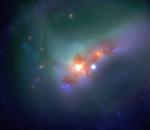 ESO202-G23: Merging Galaxies
1.01.1999
ESO202-G
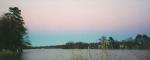 The Belt of Venus
10.11.1999
Although you've surely seen it, you might not have noticed it. During a cloudless twilight, just before sunrise or after sunset, part of the atmosphere above the horizon appears slightly off-color, slightly pink.
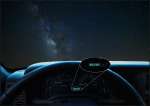 The Mileage of Light
28.05.2011
If you're driving down a dark road on a starry night, you might want to check the odometer. Earlier this month, when traveling astronomer Dennis Mammana did he was greeted with the significant mileage reading of 186,282 miles. That's the number of miles light travels in one second.
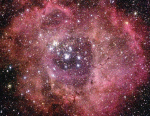 Star Cluster in the Rosette Nebula
22.05.1996
Embedded in the center of the colorful and photogenic Rosette Nebula is a bright, young open cluster. The bright blue stars in this cluster, labelled NGC 2244, emit ultraviolet light that knocks electrons away from hydrogen atoms.
|
January February March April May June July August September October |
|||||||||||||||||||||||||||||||||||||||||||||||||