
|
You entered: rings
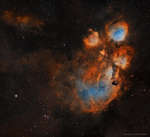 NGC 6334: The Cats Paw Nebula
13.09.2017
Nebulas are perhaps as famous for being identified with familiar shapes as perhaps cats are for getting into trouble. Still, no known cat could have created the vast Cat's Paw Nebula visible in Scorpius.
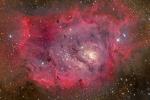 The Lagoon Nebula in Gas, Dust, and Stars
16.07.2007
Stars are battling gas and dust in the Lagoon Nebula but the photographers are winning. Also known as M8, this photogenic nebula is visible even without binoculars towards the constellation of Sagittarius. The energetic processes of star formation create not only the colors but the chaos.
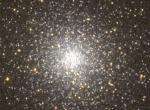 Globular Cluster 47 Tucanae
7.11.1998
Stars come in bunches. Of the over 200 globular star clusters that orbit the center of our Milky Way Galaxy, 47 Tucanae is the second brightest globular cluster (behind Omega Centauri). Known to some affectionately as 47 Tuc or NGC 104, it is only visible from the Southern
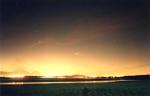 Hale-Bopp: Climbing Into Southern Skies
15.05.1997
Fighting the glow of the setting sun and the city lights of Cape Town, South Africa, comet Hale-Bopp is just visible near the center of this panoramic view - photographed on May 3rd.
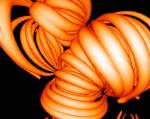 Solar Magnetic Bananas
29.06.1998
Is that our Sun? The unusual banana-shaped loops shown above are actually part of a computer-generated snap-shot of our Sun's magnetic field. This animated frame was constructed using data from the ground-based U.S. Solar Vector Magnetograph and the space-based Japanese X-Ray Telescope Yohkoh.
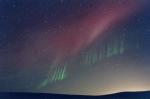 Rays from an Unexpected Aurora
20.11.2005
This aurora was a bit of a surprise. For starters, on this Friday morning in August 2002, no intense auroral activity was expected at all. Possibly more surprising, however, the aurora appeared to show an usual structure of green rays from some locations.
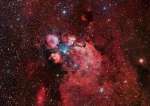 NGC 6334: The Cats Paw Nebula
18.06.2014
Nebulas are perhaps as famous for being identified with familiar shapes as perhaps cats are for getting into trouble. Still, no known cat could have created the vast Cat's Paw Nebula visible in Scorpius.
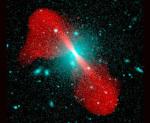 Jets from Radio Galaxy 3C296
26.02.2002
Jets of streaming plasma expelled by the central black hole of a massive elliptical galaxy likely light up this composite image of 3C296. The jets emanating from NGC 5532 and are nearly a million light years long. Exactly how the central black hole expels the infalling matter is still unknown.
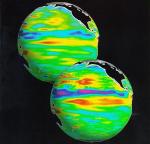 El Nino Water Rhythm
13.01.1998
This year's El Niño is the strongest ever recorded. The large amount of warm water in the Pacific Ocean near the equator is causing unusual weather all over planet Earth.
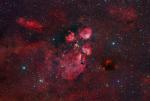 The Cats Paw Nebula
28.06.2006
Nebulae are perhaps as famous for being identified with familiar shapes as perhaps cats are for getting into trouble. Still, no known cat could have created the vast Cat's Paw Nebula visible in Scorpius.
|
January February March April May June July August September October |
|||||||||||||||||||||||||||||||||||||||||||||||||