
|
You entered: rings
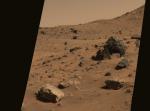 Strangers on Mars
21.07.2006
This view from the winter station of Mars Exploration Rover Spirit, looks across the rock strewn landscape of Gusev Crater. The dark boulders and distant hills are characteristic of the region...
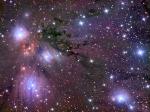 Stars, Dust and Nebula in NGC 2170
28.02.2007
When stars form, pandemonium reigns. A textbook case is the star forming region NGC 2170. Visible above are red glowing emission nebulas of hydrogen, blue reflection nebulas of dust, dark absorption nebulas of dust, and the stars that formed from them.
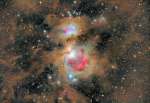 Dust of the Orion Nebula
6.02.2012
What surrounds a hotbed of star formation? In the case of the Orion Nebula -- dust. The entire Orion field, located about 1600 light years away, is inundated with intricate and picturesque filaments of dust.
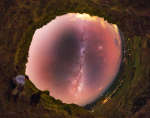 A Sky Portal in New Zealand
29.07.2014
To some, it may look like a portal into the distant universe. To others, it may appear as the eye of a giant. Given poetic license, both are correct. Pictured above is a standard fisheye view of the sky -- but with an unusual projection.
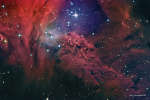 The Fox Fur Nebula
30.12.2015
This interstellar canine is formed of cosmic dust and gas interacting with the energetic light and winds from hot young stars. The shape, visual texture, and color, combine to give the region the popular name Fox Fur Nebula.
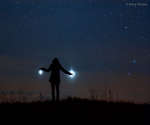 APOD: 2026 June 7 Б Jupiter and Venus from Earth
7.06.2026
It was visible around the world. The sunset conjunction of Jupiter (left) and Venus (right) in 2012 was visible almost no matter where you lived on Earth. Anyone on our planet with a clear western horizon at sunset could see them.
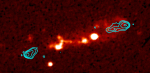 An Energetic Radio Galaxy
30.09.1995
The radio and optical emission seen in the above superposed images of the radio galaxy 3C368 indicate that energetic processes are at work. A radio galaxy is a galaxy that is visible to radio telescopes. A large radio signal usually indicates very powerful phenomena.
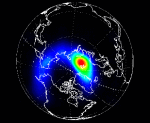 X-Ray Earth
30.12.1996
The Earth glows in many kinds of light, including the energetic X-ray band. Actually, the Earth itself does not glow - only aurora produced high in the Earth's atmosphere. Above is the first picture of the Earth in X-rays, taken in March with the orbiting Polar satellite. Bright X-ray emission is shown in red.
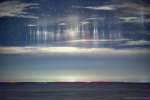 Light Pillars over Whitefish Bay
24.10.2018
What's happening in the sky? Unusual lights appeared last week to hover above Whitefish Bay on the eastern edge of Lake Superior between the USA and Canada. Unsure of the cause, the Michigan-based...
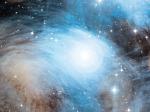 The Merope Reflection Nebula
11.06.2007
Reflection nebulas reflect light from a nearby star. Many small carbon grains in the nebula reflect the light. The blue color typical of reflection nebula is caused by blue light being more efficiently scattered by the carbon dust than red light.
|
January February March April May June July August September October |
|||||||||||||||||||||||||||||||||||||||||||||||||