
|
You entered: rings
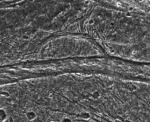 Mysterious Features on Ganymede
9.12.1997
Where is the rest of the circle? Jupiter's largest moon Ganymede has some truly unusual terrain, including the pictured half circle above cut by nearly parallel curves. Full circles can be easily explained by impact craters, but partial circles imply that some resurfacing has occurred since the original impact.
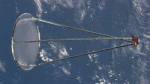 The Shuttle Launches an Inflatable Antenna
25.05.1996
High above the Earth the Space Shuttle Endeavor launches a new type of instrument - an inflatable antenna. The officially designated Inflatable Antenna Experiment was released Monday, May 20th, as part of a Spartan satellite - which contains many scientific experiments. The antenna is roughly the size of a tennis court and is even visible from Earth.
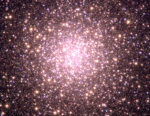 Globular Cluster M3
6.12.1996
This huge ball of stars predates our Sun. Long before mankind evolved, before dinosaurs roamed, and even before our Earth existed, ancient globs of stars condensed and orbited a young Milky Way Galaxy.
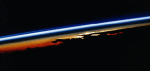 The Sun Also Rises
15.01.2000
Sunrise seen from low Earth orbit can be very dramatic indeed (and the authors don't apologize to Hemingway for using his title!). In this breathtaking view from the space shuttle Endeavor, the Sun is just visible peaking over towering anvil-shaped storm clouds.
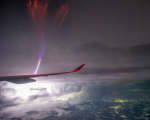 Gigantic Jet Lightning over India
18.09.2019
Yes, but can your lightning bolt do this? While flying from Munich to Singapore earlier this month, an industrious passenger took images of a passing lightning storm and caught something unexpected: gigantic jet lightning. The jet was captured on a single 3.2-second exposure above Bhadrak, India.
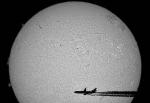 An Airplane in Front of the Sun
29.01.2001
Sometimes, good planes come to those who wait. Experienced solar photographer Thierry Lagault had noticed planes crossing in front of the Sun from his home in suburban Paris. He then got the idea for the above photograph, but had to wait through many near misses.
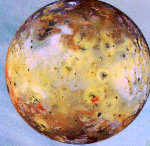 Io Full Face
29.10.1996
Io is a colorful place. The closest large moon of Jupiter, Io is the most volcanic moon in the Solar System with its surface being completely buried in volcanic lava every few thousand years.
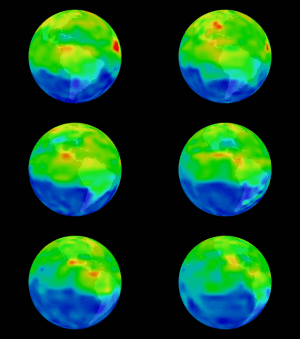 Air Pollution Earth
9.07.2001
Where on Earth is the air most polluted? Recently released images from the Terra satellite show not only areas of high pollution, but also how polluted air moves. In the above image, locations of higher air pollution are shown in red. The pollutant tracked is carbon monoxide (CO) at a height of about 5 kilometers.
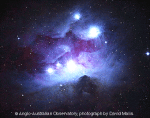 NGC 1977: Blue Reflection Nebula in Orion
20.03.1996
The Orion Nebula is visible to the unaided eye as a fuzzy patch near the famous belt of three stars in the constellation Orion. The above picture captures a part of the Orion Nebula that primarily reflects light from bright Orion stars.
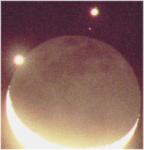 Occultations and Rising Moons
13.05.1998
On April 23, the rising crescent Moon occulted (passed in front of) Venus and Jupiter. The double occultation was a rare event and only visible from certain locations tracing a path across Earth's surface. This dramatic telephoto picture was taken at one such location, Ascension Island in the South Atlantic.
|
January February March April May June July August September October |
|||||||||||||||||||||||||||||||||||||||||||||||||