
|
You entered: rings
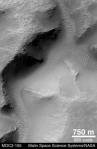 A Martian Valley
23.07.1999
This tantalizing close-up detail of a network of martian valleys was recorded from orbit this April by Mars Global Surveyor's camera. Water may once have flowed here but now sand dunes stripe the windswept valley floor.
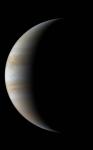 Farewell Jupiter
8.08.2001
Next stop: Saturn. The Cassini spacecraft, launched from Earth four years ago, has now swung past Jupiter and should arrive at Saturn in the year 2004. Pictured to the left is a parting shot from Cassini in January that would not have been possible from Earth: Jupiter showing a crescent phase.
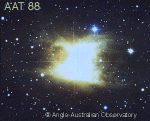 The Toby Jug Nebula
5.01.1996
Is the only thing unusual about this nebula its shape? Pictured above is the IC 2220 - the Toby Jug Nebula - a reflection nebula surrounding a normal red giant star. Reflection nebulae shine by light reflected from the central star(s).
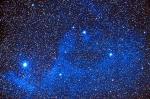 Starlight Reflections
14.04.1998
Wisps of dust fill the space between the stars. This dust is usually invisible, subtly acting to dim the light of more distant stars. Sometimes this dust is thick and prominent as dark patches on otherwise bright emission nebulae. Other times this dust may show itself by reflecting the light of bright, nearby stars.
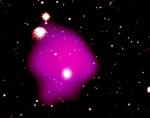 Hot Gas and Dark Matter
4.04.1999
Is the gravity of the galaxies seen in this image high enough to contain the glowing hot gas? Superposed on an optical picture of a group of galaxies is an image taken in X-ray light.
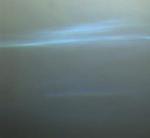 Ice Clouds over Mars
13.10.1997
Mars has clouds too. The above true color image taken in August by Mars Pathfinder shows clouds of ice high in the Martian atmosphere. Unlike Earth's atmosphere which is composed predominantly of nitrogen and oxygen, Mars' atmosphere is composed mostly of carbon dioxide.
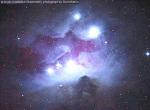 NGC 1977: Blue Reflection Nebula in Orion
22.07.2001
The Orion Nebula is visible to the unaided eye as a fuzzy patch near the famous belt of three stars in the Orion. The above picture captures a part of the Orion Nebula that primarily reflects light from bright Orion stars.
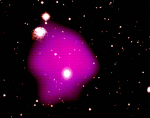 Hot Gas and Dark Matter
2.09.1995
Is the gravity of the above galaxies high enough to contain the glowing hot gas? Superposed on an optical picture of a group of galaxies is an image taken in X-ray light. The X-ray...
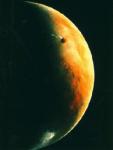 Barsoom
31.03.2001
"Yes, I have been to Barsoom again ..." begins John Carter in Edgar Rice Burroughs' 1913 science fiction classic "The Gods of Mars". In Burroughs' novels describing Carter's adventures on Mars, "Barsoom" is the local inhabitants' name for the Red Planet. Long after Burroughs' stories were published, Mars continues to inspire Earthdwellers' interests and imagination.
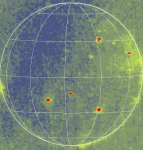 Io's Active Volcanoes
27.10.1996
Why is Io green at night? In this just-released nighttime picture of Jupiter's moon Io, the red spots clearly show Io's current volcanically active regions. But what is causing the global green sheen? This telling picture was taken by the automated Galileo spacecraft currently orbiting Jupiter while Io was in Jupiter's shadow.
|
January February March April May June July August September October |
|||||||||||||||||||||||||||||||||||||||||||||||||