
|
You entered: rings
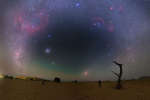 A Gegenschein Lunar Eclipse
14.10.2015
Is there anything interesting to see in the direction opposite the Sun? One night last month, there were quite a few things. First, the red-glowing orb on the lower right of the featured image is the full moon, darkened and reddened because it has entered Earth's shadow.
 APOD: 2023 September 20 Б Methane Discovered on Distant Exoplanet
20.09.2023
Where else might life exist? One of humanity's great outstanding questions, locating planets where extrasolar life might survive took a step forward in 2019 with the discovery of a significant amount of water vapor in the atmosphere of distant exoplanet K2-18b.
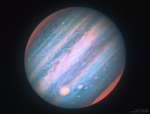 Jupiter in Infrared from Hubble
21.02.2018
Jupiter looks a bit different in infrared light. To better understand Jupiter's cloud motions and to help NASA's robotic Juno spacecraft understand the Hubble Space Telescope is being directed to regularly image the entire Jovian giant.
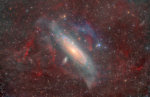 APOD: 2026 June 3 Б Andromeda Through Gas and Dust
3.06.2026
Over 1000 years ago, Persian astronomer Abd al-Rahman al-Sufi published humanityБs oldest known record of the Andromeda Galaxy in "The Book of Fixed Stars" (Bodleian Library MS. Marsh 144 p. 167). 800 years later, Andromeda became the 31st entry in Charles MessierБs "Catalogue of Nebulae and Star Clusters".
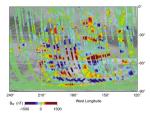 Magnetic Mars
4.05.1999
Mapping Mars from orbit, instruments on the Mars Global Surveyor (MGS) spacecraft have recently revealed banded magnetic field patterns - a startling and unanticipated suggestion that the Red Planet was more Earth-like in its distant past.
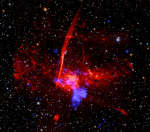 APOD: 2026 June 18 Б Possible Supernova Remnant in Galactic Center
18.06.2026
Do you see that blue blob to the lower right of the image center? Astronomers think that it shows where a massive star exploded as a supernova whose light reached Earth 1,700 years ago.
 The Dark River to Antares
16.05.2020
A dark river seems to flow through this sky from the horizon toward colorful clouds near red giant star Antares. Murky looking, the dark river is a dusty nebula obscuring background starlight near the central Milky Way, although the dark dust nebula contains mostly hydrogen molecular gas.
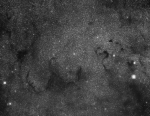 The Snake Nebula in Ophiuchus
11.08.1996
What slithers there? The dark curly lanes visible in part of the constellation Ophiuchus belong to the Snake Nebula. The Snake Nebula is a series of dark absorption clouds. Interstellar dust grains - composed predominantly of carbon - absorb visible starlight and reradiate much of it in the infrared.
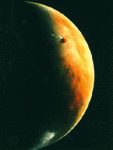 Barsoom
28.06.1997
"Yes, I have been to Barsoom again ..." begins John Carter in Edgar Rice Burroughs' 1913 science fiction classic "The Gods of Mars". In Burroughs' novels describing Carter's adventures on Mars, "Barsoom" is the local name for the red planet. Mars continues to inspire Earthdwellers' interests and imagination.
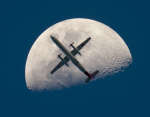 An Airplane in Front of the Moon
29.09.2010
If you look closely at the Moon, you will see a large airplane in front of it. Well, not always. OK, hardly ever. But if you wait for days with your camera attached to a Moon tracker in a place where airplanes are known to pass, you might catch a good photograph of it.
|
January February March April May June July August September October |
|||||||||||||||||||||||||||||||||||||||||||||||||