
|
You entered: rings
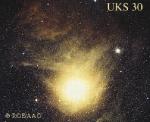 Antares
24.06.1997
Antares is a huge star. In a class called red supergiant, Antares is about 700 times the size of our own Sun, 15 times more massive, and 10,000 times brighter. Antares is the brightest star in the constellation of Scorpius and one of the brighter stars in all the night sky.
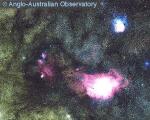 The Sky Towards Sagittarius
7.09.1998
A variety of stars and nebulae can be found towards the constellation of Sagittarius. Dense fields of stars laced with dark lanes of dust crowd this region only a few degrees from the center of our Galaxy.
 The Night Shift
17.12.1998
For the orbiting International Space Station (ISS), the sun sets every 90 minutes. But working through the night, spacewalking astronauts can rely on artificial lighting. Here, the eerie glow of work-lights illuminate Space Shuttle Endeavor astronaut Jerry Ross during a night on his
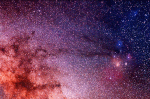 The Pipe Dark Nebula
28.05.1996
The dark nebula predominant at the lower left of the above photograph is known as the Pipe Nebula. The dark clouds, suggestively shaped like smoke rising from a pipe, are caused by absorption of background starlight by dust.
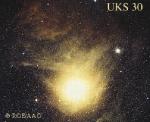 Antares
26.07.1998
Antares is a huge star. In a class called red supergiant, Antares is about 700 times the diameter of our own Sun, 15 times more massive, and 10,000 times brighter. Antares is the brightest star in the constellation of Scorpius and one of the brighter stars in all the night sky.
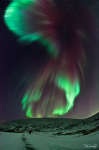 A Memorable Aurora Over Norway
5.12.2011
It was one of the most memorable auroras of the season. There was green light, red light, and sometimes a mixture of the two. There were multiple rays, distinct curtains, and even an auroral corona. It took up so much of the sky.
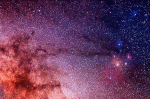 The Pipe Dark Nebula
21.06.1997
The dark nebula predominant at the lower left of the above photograph is known as the Pipe Nebula. The dark clouds, suggestively shaped like smoke rising from a pipe, are caused by absorption of background starlight by dust.
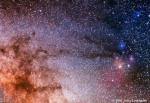 The Pipe Dark Nebula
5.03.2000
The dark nebula predominant at the lower left of the above photograph is known as the Pipe Nebula. The dark clouds, suggestively shaped like smoke rising from a pipe, are caused by absorption of background starlight by dust.
 The Grand Canyon of Mars
20.07.1995
The Mariner Valley, also known as the Valles Marineris canyon system, appears in this mosaic of images from NASA's Viking spacecraft as a huge gouge across the red planet. This "Grand Canyon" of Mars is about 2500 miles long and up to 4 miles deep.
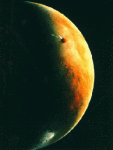 Barsoom
24.04.1999
"Yes, I have been to Barsoom again ..." begins John Carter in Edgar Rice Burroughs' 1913 science fiction classic "The Gods of Mars". In Burroughs' novels describing Carter's adventures on Mars, "Barsoom" is the local inhabitants' name for the Red Planet. Long after Burroughs' stories were published, Mars continues to inspire Earthdwellers' interests and imagination.
|
January February March April May June July August September October |
|||||||||||||||||||||||||||||||||||||||||||||||||