
|
You entered: rings
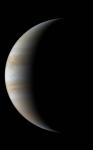 Farewell Jupiter
8.08.2001
Next stop: Saturn. The Cassini spacecraft, launched from Earth four years ago, has now swung past Jupiter and should arrive at Saturn in the year 2004. Pictured to the left is a parting shot from Cassini in January that would not have been possible from Earth: Jupiter showing a crescent phase.
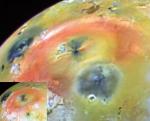 Dark Volcano Active on Io
10.11.1997
The surface of Io is changing even as we watch. The inset frame of Jupiter's most active moon was taken by the robot spacecraft Galileo in April. Just last month the larger image was taken. The new large black spot reveals that a volcano named Pillan Patera has been erupting during the interim.
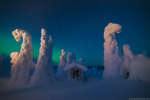 Sentinels of a Northern Sky
10.01.2017
Who guards the north? The featured picture was taken last March in Finnish Lapland where weather can include sub-freezing temperatures and driving snow. Surreal landscapes sometimes result, where white alien-looking sentinels seem to patrol the landscape.
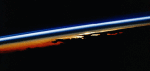 The Sun Also Rises
24.10.1998
Sunrise seen from low Earth orbit by the shuttle astronauts can be very dramatic indeed ( and the authors apologize to Hemingway for using his title!). In this breathtaking view, the Sun is just visible...
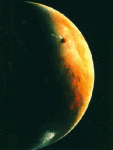 Barsoom
17.07.1995
"Yes, I have been to Barsoom again ..." begins John Carter in Edgar Rice Burroughs' 1913 science fiction classic "The Gods of Mars". In Burroughs' novels describing Carter's adventures on Mars, "Barsoom" is the local name for the red planet.
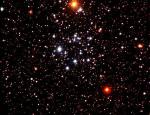 Open Cluster M50
28.01.1997
Many stars form in clusters. Two types of star clusters are visible in our Milky Way Galaxy: open clusters and globular clusters. Open clusters like M50, shown above, typically contain hundreds of stars, many of which are bright, young, and blue.
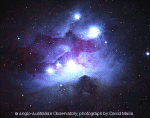 NGC 1977: Blue Reflection Nebula in Orion
1.02.1998
The Orion Nebula is visible to the unaided eye as a fuzzy patch near the famous belt of three stars in the constellation Orion. The above picture captures a part of the Orion Nebula that primarily reflects light from bright Orion stars.
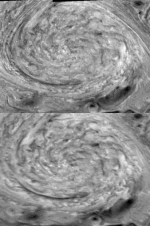 A New Jupiter Oval Rotates
5.01.1999
Even Jupiter can do the twist. Large cloud systems on Jupiter rotate, and the newly formed oval pictured above is no different. This new oval formed earlier this year from the collision of two smaller ovals: an occurrence not unlike two large storms merging into one huge hurricane.
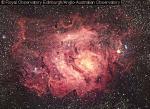 M8: The Lagoon Nebula
7.07.1998
The bright Lagoon Nebula is home to a diverse array of astronomical objects. Particularly interesting sources include a bright open cluster of stars and several energetic star-forming regions. The general red glow is caused by luminous hydrogen gas, while the dark filaments are caused by absorption by dense lanes of dust.
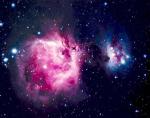 The Great Nebula in Orion
27.01.1998
The Great Nebula in Orion can be found just below and to the left of the easily identifiable belt of three stars in the popular constellation Orion. This fuzzy patch contains one of the closest stellar nurseries, lying at a distance of about 1500 light years.
|
January February March April May June July August September October |
|||||||||||||||||||||||||||||||||||||||||||||||||