
|
You entered: light
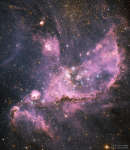 NGC 346: Star Forming Cluster in the SMC
1.12.2020
Are stars still forming in the Milky Way's satellite galaxies? Found among the Small Magellanic Cloud's (SMC's) clusters and nebulas, NGC 346 is a star forming region about 200 light-years across, pictured here in the center of a Hubble Space Telescope image.
 Flemings Triangular Wisp
27.07.2021
Chaotic in appearance, these tangled filaments of shocked, glowing gas are spread across planet Earth's sky toward the constellation of Cygnus as part of the Veil Nebula. The Veil Nebula itself is a large supernova remnant, an expanding cloud born of the death explosion of a massive star.
 APOD: 2024 January 15 Б Star Cluster IC 348 from Webb
15.01.2024
Sometimes, it's the stars that are the hardest to see that are the most interesting. IC 348 is a young star cluster that illuminates surrounding filamentary dust. The stringy and winding dust appears pink in this recently released infrared image from the Webb Space Telescope.
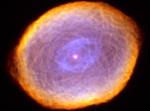 IC 418: The Spirograph Nebula
14.12.2002
What is creating the strange texture of IC 418? Dubbed the Spirograph Nebula for its resemblance to drawings from a cyclical drawing tool, planetary nebula IC 418 shows patterns that are not well understood. Perhaps they are related to chaotic winds from the variable central star, which changes brightness unpredictably in just a few hours.
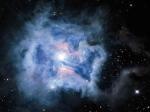 The Iris Nebula from CFHT
29.12.2005
Like delicate cosmic petals, these clouds of interstellar dust and gas have blossomed 1,300 light-years away in the fertile star fields of the constellation Cepheus. Sometimes called the Iris Nebula and dutifully cataloged as NGC 7023, this is not the only nebula in the sky to evoke the imagery of flowers.
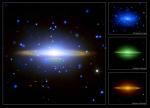 Sombrero Galaxy Across the Spectrum
5.05.2007
Appropriately famous for its broad ring of obscuring dust and hat-like appearance, the Sombrero Galaxy (aka spiral galaxy M104) is featured in this unique composite view that spans the electromagnetic spectrum, from three major space-based observatories.
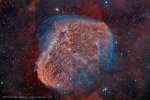 NGC 6888: The Crescent Nebula
15.09.2009
NGC 6888, also known as the Crescent Nebula, is a cosmic bubble about 25 light-years across, blown by winds from its central, bright, massive star. This beautiful portrait of the nebula is from the Isaac Newton Telescope at Roque de los Muchachos Observatory in the Canary Islands.
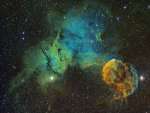 The Elusive Jellyfish Nebula
15.05.2010
Normally faint and elusive, the Jellyfish Nebula is caught in this alluring, false-color, telescopic view. Flanked by two bright stars, Mu and Eta Geminorum, at the foot of a celestial twin, the Jellyfish Nebula is the brighter arcing ridge of emission with dangling tentacles below and right of center.
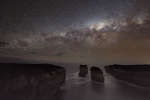 A Milky Way Shadow at Loch Ard Gorge
23.08.2010
Have you ever seen the Milky Way's glow create shadows? To do so, conditions need to be just right. First and foremost, the sky must be relatively clear of clouds so that the long band of the Milky Way's central disk can be seen.
 Star Streams of NGC 4216
27.11.2010
Some 40 million light-years distant, edge-on spiral galaxy NGC 4216 is nearly 100,000 light-years across, about the size of our own Milky Way. Found in the dense Virgo Galaxy Cluster, NGC 4216 is centered in this deep telescopic portrait flanked by fellow Virgo cluster members NGC 4206 (right) and NGC 4222.
|
January February March April May June July August September October |
|||||||||||||||||||||||||||||||||||||||||||||||||