
|
You entered: light
 Moon Venus Mars Skyline
27.02.2015
Taken on February 20, five different exposures made in rapid succession were used to created this tantalizing telephoto image. In combination, they reveal a wide range of brightness visible to the eye on that frigid evening, from the urban glow of the Quebec City skyline to the triple conjunction of Moon, Venus and Mars.
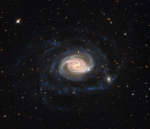 NGC 289: Swirl in the Southern Sky
4.04.2018
About 70 million light-years distant, gorgeous spiral galaxy NGC 289 is larger than our own Milky Way. Seen nearly face-on, its bright core and colorful central disk give way to remarkably faint, bluish spiral arms. The extensive arms sweep well over 100 thousand light-years from the galaxy's center.
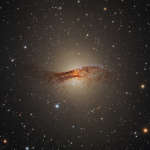 Centaurus A
11.07.2018
Only 11 million light-years away, Centaurus A is the closest active galaxy to planet Earth. Spanning over 60,000 light-years, the peculiar elliptical galaxy also known as NGC 5128, is featured in this sharp telescopic view.
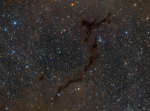 Barnard 150: Seahorse in Cepheus
24.10.2018
Light-years across, this suggestive shape known as the Seahorse Nebula appears in silhouette against a rich, luminous background of stars. Seen toward the royal northern constellation of Cepheus, the dusty, obscuring clouds are part of a Milky Way molecular cloud some 1,200 light-years distant.
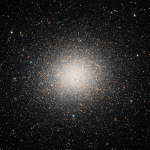 Millions of Stars in Omega Centauri
23.08.2019
Globular star cluster Omega Centauri, also known as NGC 5139, is some 15,000 light-years away. The cluster is packed with about 10 million stars much older than the Sun within a volume about 150 light-years in diameter.
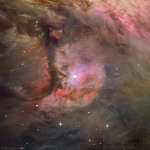 M43: Dust, Gas, and Stars in the Orion Nebula
5.07.2020
Unspeakable beauty and unimaginable bedlam can be found together in the Orion Nebula Arguably the most famous of all astronomy nebulas, the Great Nebula in Orion is an immense interstellar molecular cloud only 1500 light-years away.
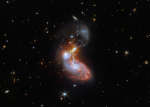 Merging Galaxy Pair IIZw096
1.12.2022
Bright at infrared wavelengths, this merging galaxy pair is some 500 million light-years away toward the constellation Delphinus. The cosmic mashup is seen against a background of even more distant galaxies, and occasional spiky foreground stars. But the galaxy merger itself spans about 100,000 light-years in this deep James Webb Space Telescope image.
 The Dark Seahorse of Cepheus
18.09.2024
Spanning light-years, this suggestive shape known as the Seahorse Nebula floats in silhouette against a rich, luminous background of stars. Seen toward the royal northern constellation of Cepheus, the dusty, dark nebula is part of a Milky Way molecular cloud some 1,200 light-years distant.
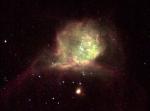 Star Forming Region Hubble X
15.02.2001
In nearby galaxy NGC 6822, this glowing emission nebula complex surrounds bright, massive, newborn stars. A mere 4 million years young, these stars condensed from the galaxy's interstellar gas and dust clouds.
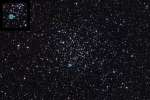 Stars Young and Old
25.03.2009
Galactic or open star clusters are relatively young. These swarms of stars are born near the plane of the Milky Way, but their numbers steadily dwindle as cluster members are strewn through the Galaxy by gravitational interactions.
|
January February March April May June July August September October |
|||||||||||||||||||||||||||||||||||||||||||||||||