
|
You entered: light
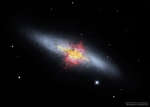 The Central Magnetic Field of the Cigar Galaxy
11.03.2019
Are galaxies giant magnets? Yes, but the magnetic fields in galaxies are typically much weaker than on Earth's surface, as well as more complex and harder to measure. Recently, though, the HAWC+ instrument...
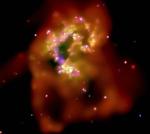 X Rays From Antennae Galaxies
3.02.2004
A bevy of black holes and neutron stars shine as bright, point-like sources against bubbles of million degree gas in this false-color x-ray image from the orbiting Chandra Observatory. The striking picture spans about...
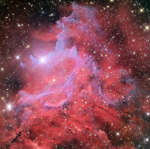 Flaming Star Nebula
1.12.2016
A runaway star lights the Flaming Star Nebula in this cosmic scene. Otherwise known as IC 405, the Flaming Star Nebula's billowing interstellar clouds of gas and dust lie about 1,500 light-years away toward the constellation of Auriga.
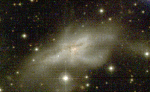 NGC 6240: When Galaxies Collide
28.12.1995
Sometimes even galaxies can suffer a fatal attraction. Here gravity causes two galaxies to collide in a spectacular display of energetic gas, dust, and light. When galaxies collide it is rare that any stars in the galaxies themselves collide, or that any change will be seen in a human lifetime.
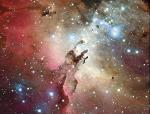 The Eagle Nebula from CFHT
13.02.2003
Bright blue stars are still forming in the dark pillars of the Eagle Nebula. Made famous by a picture from the Hubble Space Telescope in 1995, the Eagle Nebula shows the dramatic process of star formation. To the upper right of the nebula in the above picture lies the heart of the open cluster M16.
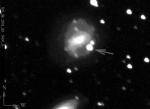 A Gamma Ray Burst Supernova
8.05.1998
Did a gamma-ray burst precede this supernova? This intriguing suggestion came to light yesterday with the discovery of an evolving supernova that is potentially coincident with the position of gamma-ray burst GRB 980425, which occurred just two weeks ago. If true, this would tie together the two most violent phenomena known in the universe.
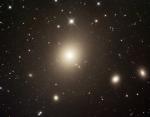 Elliptical Galaxy M87
20.05.2006
In spiral galaxies, majestic winding arms of young stars and interstellar gas and dust rotate in a flat disk around a bulging galactic nucleus. But elliptical galaxies seem to be simpler. Lacking gas and dust to form new stars, their randomly swarming older stars, give them an ellipsoidal (egg-like) shape.
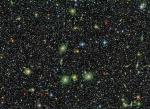 Galaxies Cluster Toward the Great Attractor
4.01.2000
Galaxies dot the sky like jewels in the direction of a mass so large it is known simply as the Great Attractor. The galaxies pictured above are part of a cluster of galaxies called ACO 3627 near the center of the Great Attractor.
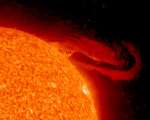 A Solar Prominence Unfurls
4.10.2008
On September 29, this magnificent eruptive solar prominence lifted away from the Sun's surface, unfurling into space over the course of several hours. Suspended in twisted magnetic fields, the hot plasma structure is many times the size of planet Earth and was captured in this view by the Sun-watching STEREO (Ahead) spacecraft.
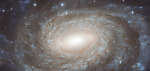 NGC 6384: Spiral Beyond the Stars
22.03.2011
The universe is filled with galaxies. But to see them astronomers must look out beyond the stars of our galaxy, the Milky Way. For example, consider this colorful telescopic view of spiral galaxy NGC 6384, about 80 million light-years away in the direction of the constellation Ophiuchus.
|
January February March April May June July August September October |
|||||||||||||||||||||||||||||||||||||||||||||||||