
|
You entered: light
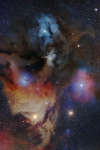 APOD: 2026 July 1 Б The Cotton Candy Clouds of Rho Ophiuchi
1.07.2026
Although they look like cotton candy, you cannot eat these clouds! Taken in Cádiz, Spain, today's image features the Rho Ophiuchi complex, a rich tapestry of young and old astronomical phenomena. This colorful cloud complex is a nearby star-forming region containing hundreds of young stellar objects, including protostars and T Tauri stars.
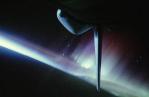 Aurora Astern
10.02.2001
Sailing upside down, 115 nautical miles above Earth, the crew of the Space Shuttle Endeavour made this spectacular time exposure of the southern aurora (aurora australis) in October of 1994. Aurora, also known as the northern and southern lights, appear as luminous bands or streamers of light which can extend to altitudes of 200 miles.
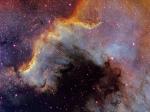 The Cygnus Wall of Star Formation
21.06.2005
The North America Nebula in the sky can do what North Americans on Earth cannot -- form stars. Specifically, in analogy to the Earth-confined continent, the bright part that appears as Central America and Mexico is actually a hot bed of gas, dust, and newly formed stars known as the Cygnus Wall.
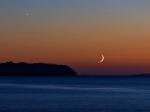 Moon River
9.09.2005
Shortly after sunset on September 6th, sky gazers around the world were treated to a lovely crescent Moon in western skies -- joined by bright planets Venus and Jupiter. In this colorful telephoto view from near Quebec City, Canada the Moon is nestled just above the wide St. Lawrence River.
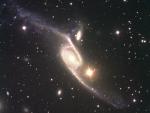 NGC 6872: A Stretched Spiral
25.05.1999
What makes NGC 6872 so long? Measuring over 700,000 light years across from top to bottom, NGC 6872 is one of the largest barred spiral galaxies known. The galaxy's elongated shape might have something to do with its continuing collision with the smaller galaxy IC 4970, visible just above center.
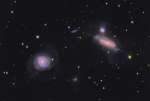 NGC 7771 Galaxy Group
29.08.2009
Slide your cursor over the image to identify three members of this intriguing gathering of galaxies. Known as the NGC 7771 Group, they lie almost 200 million light-years away toward the high flying constellation Pegasus.
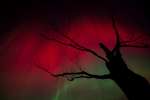 October Skylights
28.10.2011
As northern hemisphere nights grow longer, October is a good month for spotting auroras, or even other eerie apparitions after dark. And this week the night sky did not disappoint. On October 24th a solar coronal mass ejection impacted planet Earth's magnetosphere triggering far ranging auroral displays.
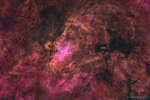 Nest of the Eagle Nebula
4.10.2016
What surrounds the famous Eagle Nebula? The inside of the Eagle Nebula contains eggs -- evaporating gaseous globules -- that typically reside in tremendous pillars of gas and dust and where stars form. This image, though...
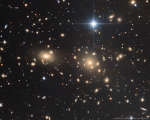 The Coma Cluster of Galaxies
26.03.2018
Almost every object in the above photograph is a galaxy. The Coma Cluster of Galaxies pictured here is one of the densest clusters known - it contains thousands of galaxies. Each of these galaxies houses billions of stars - just as our own Milky Way Galaxy does.
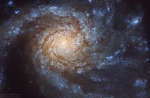 Messier 99
24.06.2021
Grand design spiral galaxy Messier 99 looks majestic on a truly cosmic scale. This recently processed full galaxy portrait stretches over 70,000 light-years across M99. The sharp view is a combination of ultraviolet, visible, and infrared image data from the Hubble Space Telescope.
|
January February March April May June July August September October |
|||||||||||||||||||||||||||||||||||||||||||||||||