
|
You entered: light
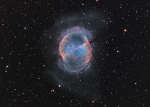 M27: Not a Comet
1.09.2011
While hunting for comets in the skies above 18th century France, astronomer Charles Messier diligently kept a list of the things he encountered that were definitely not comets. This is number 27 on his now famous not-a-comet list.
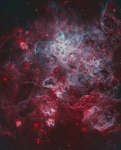 The Tarantula Zone
13.11.2020
The Tarantula Nebula, also known as 30 Doradus, is more than a thousand light-years in diameter, a giant star forming region within nearby satellite galaxy the Large Magellanic Cloud. About 180 thousand light-years away, it's the largest, most violent star forming region known in the whole Local Group of galaxies.
 APOD: 2023 November 21 Б Flemings Triangular Wisp
21.11.2023
These chaotic and tangled filaments of shocked, glowing gas are spread across planet Earth's sky toward the constellation of Cygnus as part of the Veil Nebula. The Veil Nebula itself is a large supernova remnant, an expanding cloud born of the death explosion of a massive star.
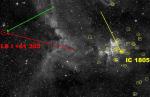 Microquasar in Motion
16.09.2004
Microquasars, bizarre binary star systems, generating high-energy radiation and blasting out jets of particles at nearly the speed of light, live in our Milky Way galaxy. The energetic microquasar systems seem to consist...
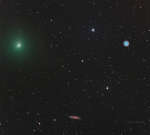 The Comet, the Owl, and the Galaxy
24.03.2017
Comet 41P/Tuttle-Giacobini-Kresak poses for a Messier moment in this telescopic snapshot from March 21. In fact it shares the 1 degree wide field-of-view with two well-known entries in the 18th century comet-hunting astronomer's famous catalog.
 A View Toward M101
15.03.2019
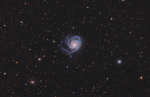
Big, beautiful spiral galaxy M101 is one of the last entries in Charles Messier's famous catalog, but definitely not one of the least. About 170,000 light-years across, this galaxy is enormous, almost twice the size of our own Milky Way galaxy.
 Webb s First Deep Field
13.07.2022
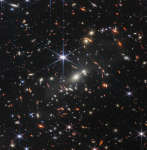
This is the deepest, sharpest infrared image of the cosmos so far. The view of the early Universe toward the southern constellation Volans was achieved in 12.5 hours of exposure with the NIRCam instrument on the James Webb Space Telescope. Of course the stars with six visible spikes are well within our own Milky Way.
 Spiral Galaxy NGC 253 Almost Sideways
2.11.1996
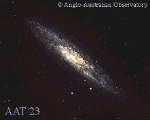
NGC 253 is a normal spiral galaxy seen here almost sideways. It is the largest member of the Sculptor Group of Galaxies, the nearest group to our own Local Group of Galaxies.
 Aurora Shimmer, Meteor Flash
19.12.2009
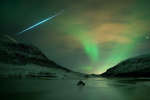
Northern Lights, or aurora borealis, haunted skies over the island of Kvaløya, near Tromsø Norway on December 13. This 30 second long exposure records their shimmering glow gently lighting the wintery coastal scene.
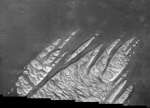 White Rock Fingers on Mars
30.10.2011
What caused this unusual light rock formation on Mars? Intrigued by the possibility that they could be lakebed dried-up, detailed studies of these fingers now indicate a more mundane possibility: volcanic ash. Studying the exact color of the formation indicated the possible volcanic origin.
|
January February March April May June July August September October |
|||||||||||||||||||||||||||||||||||||||||||||||||