
|
You entered: light
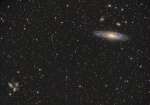 Galaxies in Pegasus
6.08.2009
This wide, sharp telescopic view reveals galaxies scattered beyond the stars at the northern boundary of the high-flying constellation Pegasus. Prominent at the upper right is NGC 7331. A mere 50 million light-years away, the large spiral is one of the brighter galaxies not included in Charles Messier's famous 18th century catalog.
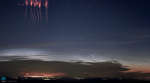 Meeting in the Mesosphere
3.07.2020
A sensitive video camera on a summit of the Vosges mountains in France captured these surprising fireworks above a distant horizon on June 26. Generated over intense thunderstorms, this one about 260 kilometers away, the brief and mysterious flashes have come to be known as red sprites.
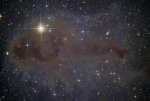 Lynds Dark Nebula
19.09.2021
Stars are forming in Lynds Dark Nebula (LDN) 1251. About 1,000 light-years away and drifting above the plane of our Milky Way galaxy, the dusty molecular cloud is part of a complex of dark nebulae mapped toward the Cepheus flare region.
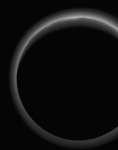 APOD: 2025 October 2 Б Pluto at Night
1.10.2025
The night side of Pluto spans this shadowy scene. In the stunning spacebased perspective, the Sun is 4.9 billion kilometers (almost 4.5 light-hours) behind the dim and distant world. It was captured by far flung New Horizons in July of 2015 when the spacecraft was at a range of some 21,000 kilometers from Pluto.
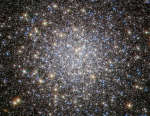 Hubble s Messier 5
3.11.2017
"Beautiful Nebula discovered between the Balance [Libra] & the Serpent [Serpens] ..." begins the description of the 5th entry in 18th century astronomer Charles Messier's famous catalog of nebulae and star clusters. Though it appeared...
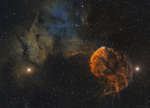 Sharpless 249 and the Jellyfish Nebula
6.03.2019
Normally faint and elusive, the Jellyfish Nebula is caught in this alluring telescopic field of view. The entire scene is a two panel mosaic constructed using narrowband image data, with emission from sulfur, hydrogen and oxygen atoms shown in red, green and blue hues.
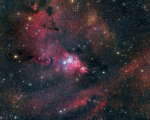 Cosmic Clouds in the Unicorn
7.02.2020
Interstellar clouds of hydrogen gas and dust abound in this gorgeous skyscape. The 3 degree wide field of view stretches through the faint but fanciful constellation Monoceros, the Unicorn. A star forming region cataloged as NGC 2264 is centered, a complex jumble of cosmic gas, dust and stars about 2,700 light-years distant.
 Jupiter in Infrared from Gemini
12.05.2020
In infrared, Jupiter lights up the night. Recently, astronomers at the Gemini North Observatory in Hawaii, USA, created some of the best infrared photos of Jupiter ever taken from EarthБs surface, pictured. Gemini...
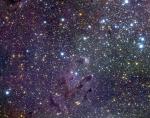 M16: Stars, Pillars and the Eagle s EGGs
2.01.2002
The Hubble Space Telescope's 1995 image of pillars of dust and gas, light-years long, within the Eagle Nebula (M16) was sensational. The three prominent pillars in that close-up visible light picture also appear...
 The W in Cassiopeia
17.03.2016
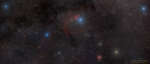
A familiar, zigzag, W pattern in northern constellation Cassiopeia is traced by five bright stars in this colorful and broad mosaic. Stretching about 15 degrees across rich starfields, the celestial scene includes dark clouds, bright nebulae, and star clusters along the Milky Way. In yellow-orange hues Cassiopeia's alpha star Shedar is a standout though.
|
January February March April May June July August September October |
|||||||||||||||||||||||||||||||||||||||||||||||||