
|
You entered: light
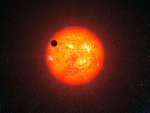 Extrasolar Super Earth Gliese 1214b Might Hold Water
10.09.2013
Might this distant planet hold water? Actually, given how close Gliese 1214b is to its parent star, any water, if it exists, would surely be in the form of steam. In the above artist...
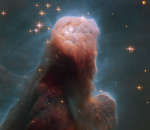 The Cone Nebula from Hubble
28.05.2014
Stars are forming in the gigantic dust pillar called the Cone Nebula. Cones, pillars, and majestic flowing shapes abound in stellar nurseries where natal clouds of gas and dust are buffeted by energetic winds from newborn stars. The Cone Nebula, a well-known example, lies within the bright galactic star-forming region NGC 2264.
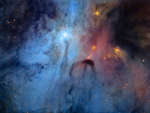 IC 4603: Reflection Nebula in Ophiuchius
23.07.2014
Why does this starfield photograph resemble an impressionistic painting? The effect is created not by digital trickery but by large amounts of interstellar dust. Dust, minute globs rich in carbon and similar in size to cigarette smoke, frequently starts in the outer atmospheres of large, cool, young stars.
 BZ Cam Bow Shock
27.11.2000
BZ Cam is a binary star system that is not well understood. In most cataclysmic variables, matter from a normal star accumulates on the surface of the companion white dwarf star, eventually causing a nova-like flare as the material becomes hot enough to ignite nuclear fusion.
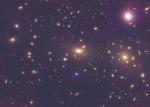 The Coma Cluster of Galaxies
6.08.2000
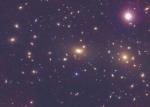
Almost every object in the above photograph is a galaxy. The Coma Cluster of Galaxies pictured above is one of the densest clusters known - it contains thousands of galaxies. Each of these galaxies houses billions of stars - just as our own Milky Way Galaxy
 The Coma Cluster of Galaxies
2.02.2002
Almost every object in the above photograph is a galaxy. The Coma Cluster of Galaxies pictured above is one of the densest clusters known - it contains thousands of galaxies. Each of these galaxies houses billions of stars - just as our own Milky Way Galaxy does.
 M31: The Andromeda Galaxy
21.10.2002
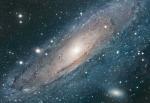
Andromeda is the nearest major galaxy to our own Milky Way Galaxy. Our Galaxy is thought to look much like Andromeda. Together these two galaxies dominate the Local Group of galaxies. The diffuse light from Andromeda is caused by the hundreds of billions of stars that compose it.
 UB313: Larger than Pluto
6.02.2006
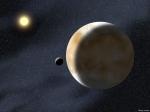
What do you call an outer Solar System object that is larger than Pluto? Nobody is yet sure. The question arose recently when 2003 UB313, an object currently twice as far out as Pluto and not in the plane with the rest of the planets, was verified recently to be 30 percent wider than Pluto.
 Two Hours Before Neptune
5.10.1999
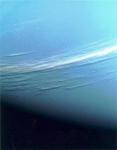
Two hours before closest approach to Neptune in 1989, the Voyager 2 robot spacecraft snapped this picture. Clearly visible for the first time were long light-colored cirrus-type clouds floating high in Neptune's atmosphere. Shadows of these clouds can even be seen on lower cloud decks.
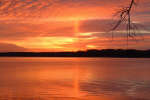 A Sun Pillar Over North Carolina
14.12.2008
Have you ever seen a sun pillar? When the air is cold and the Sun is rising or setting, falling ice crystals can reflect sunlight and create an unusual column of light. Ice sometimes forms flat, six-sided shaped crystals as it falls from high-level clouds.
|
January February March April May June July August September October |
|||||||||||||||||||||||||||||||||||||||||||||||||