
|
You entered: light
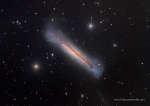 NGC 3628: The Hamburger Galaxy
3.05.2017
No, hamburgers are not this big. What is pictured is a sharp telescopic views of a magnificent edge-on spiral galaxy NGC 3628 show a puffy galactic disk divided by dark dust lanes. Of course, this deep galactic portrait puts some astronomers in mind of its popular moniker, The Hamburger Galaxy.
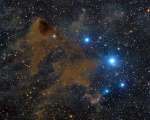 Lynds Dark Nebula 183
21.10.2017
Beverly Lynds Dark Nebula 183 lies a mere 325 light-years away, drifting high above the plane of our Milky Way Galaxy. Obscuring the starlight behind it when viewed at optical wavelengths, the dark, dusty molecular cloud itself seems starless.
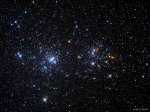 A Double Star Cluster in Perseus
18.11.2020
Most star clusters are singularly impressive. Open clusters NGC 869 and NGC 884, however, could be considered doubly impressive. Also known as "h and chi Persei", this unusual double cluster, shown above, is bright enough to be seen from a dark location without even binoculars.
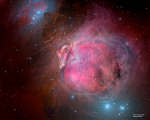 The Great Turkey Nebula
26.11.2020
Surprisingly reminiscent of The Great Nebula in Orion, The Great Turkey Nebula spans this creative field of view. Of course if it were the Orion Nebula it would be our closest large stellar nursery, found at the edge of a large molecular cloud a mere 1,500 light-years away.
 Galaxy by the Lake
10.09.2022
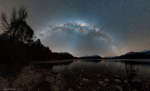
This 180 degree panoramic night skyscape captures our Milky Way Galaxy as it arcs above the horizon on a winter's night in August. Near midnight, the galactic center is close to the zenith with the clear waters of Lake Traful, Neuquen, Argentina, South America, planet Earth below.
 Simeis 147: Supernova Remnant
9.10.2012
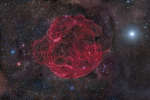
It's easy to get lost following the intricate filaments in this detailed mosaic image of faint supernova remnant Simeis 147 (S147). Also cataloged as Sh2-240, it covers nearly 3 degrees or 6 full moons on the sky. That's about 150 light-years at the stellar debris cloud's estimated distance of 3,000 light-years.
 Orbiting a Black Hole
1.07.2013
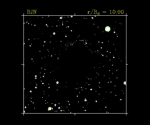
What would it look like to orbit a black hole? Since the strong gravity of the black hole can significantly alter light paths, conditions would indeed look strange. For one thing, the entire sky would be visible, since even stars behind the black hole would have their light bent to the observer's eye.
 Arp 188 and the Tadpoles Tail
25.08.2014
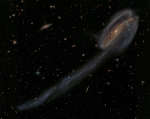
Why does this galaxy have such a long tail? In this stunning vista, based on image data from the Hubble Legacy Archive, distant galaxies form a dramatic backdrop for disrupted spiral galaxy Arp 188, the Tadpole Galaxy. The cosmic tadpole is a mere 420 million light-years distant toward the northern constellation Draco.
 A Cosmic Zoo in Cepheus
17.08.2023
Sprawling emission nebulae IC 1396 and Sh2-129 mix glowing interstellar gas and dark dust clouds in this nearly 12 degree wide field of view toward the northern constellation Cepheus the King. Energized by its central star IC 1396 (left), is hundreds of light-years across and some 3,000 light-years distant.
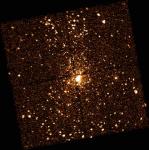 X-Ray Stars Of Orion
4.02.2000
The stars of Orion shine brightly in northern winter skies where the constellation harbors the closest large stellar nursery, the Great Nebula of Orion, a mere 1500 light-years away. In fact, the apparently bright...
|
January February March April May June July August September October |
|||||||||||||||||||||||||||||||||||||||||||||||||