
|
You entered: light
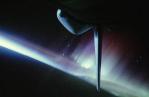 Aurora Astern
30.11.1996
Sailing upside down, 115 nautical miles above Earth, the crew of the Space Shuttle Endeavour made this spectacular time exposure of the southern aurora (aurora australis) in October of 1994. The aurora, also known...
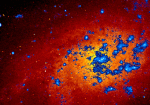 M33: The Triangulum Galaxy
8.07.1996
The spiral galaxy M33 is a mid-sized member of our Local Group of galaxies. M33 is also called the Triangulum Galaxy for the constellation in which it resides. About four times smaller (in radius)...
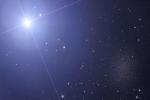 Bright Star Regulus near the Leo 1 Dwarf Galaxy
19.06.2006
The star on the upper left is so bright it is sometimes hard to notice the galaxy on the lower right. Both the star, Regulus, and the galaxy, Leo I, can be found within one degree of each other toward the constellation of Leo.
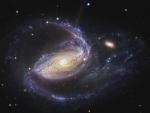 In the Arms of NGC 1097
1.12.2006
A smaller companion seems wrapped in the spiral arms of enigmatic galaxy NGC 1097. This amazingly deep image of the peculiar spiral system, also known as Arp 77, actually combines data from two telescopes, one in the northern and one in the southern hemisphere of planet Earth.
 Two Hours Before Neptune
8.08.2010
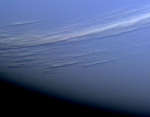
Two hours before closest approach to Neptune in 1989, the Voyager 2 robot spacecraft snapped this picture. Clearly visible for the first time were long light-colored cirrus-type clouds floating high in Neptune's atmosphere. Shadows of these clouds can even be seen on lower cloud decks.
 Globular Star Cluster NGC 6934
9.10.2010
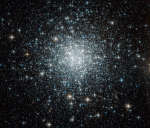
Globlular star clusters roam the halo of our Milky Way Galaxy. Gravitationally bound, these spherical groupings of typically several hundred thousand stars are ancient, older than the stars of the galactic disk. In fact...
 M7: Open Star Cluster in Scorpius
13.07.2016
M7 is one of the most prominent open clusters of stars on the sky. The cluster, dominated by bright blue stars, can be seen with the naked eye in a dark sky in the tail of the constellation of the Scorpion (Scorpius).
 Hubble s NGC 1546
21.06.2024
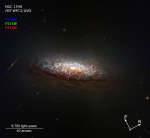
Returning to science operations on June 14, the Hubble Space Telescope used its new pointing mode to capture this sharp image of spiral galaxy NGC 1546. A member of the Dorado galaxy group, the island universe lies a mere 50 million light-years away.
 Cat s Eye Hubble Remix
22.03.2008
Staring across interstellar space, the alluring Cat's Eye Nebula lies three thousand light-years from Earth. One of the most famous planetary nebulae in the sky, the Cat's Eye (NGC 6543) is over half a light-year across and represents a final, brief yet glorious phase in the life of a sun-like star.
 A Protected Night Sky Over Flagstaff
16.04.2008
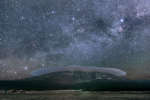
This sky is protected. Yesterday marked the 50 year anniversary of the first lighting ordinance ever enacted, which restricted searchlight advertisements from sweeping the night skies above Flagstaff, Arizona, USA. Flagstaff now enjoys...
|
January February March April May June July August September October |
|||||||||||||||||||||||||||||||||||||||||||||||||