
|
You entered: dust
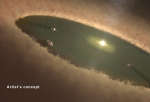 The Double Dust Disks of HD 95086
16.11.2014
What do other star systems look like? To help find out, astronomers are carrying out detailed observations of nearby stars in infrared light to see which have dust disks that might be forming planets.
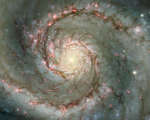 M51: The Whirlpool Galaxy in Dust and Stars
24.02.2013
The Whirlpool Galaxy is a classic spiral galaxy. At only 30 million light years distant and fully 60 thousand light years across, M51, also known as NGC 5194, is one of the brightest and most picturesque galaxies on the sky.
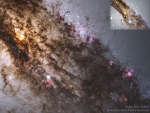 A Supernova through Galaxy Dust
23.02.2016
Telescopes around the world are tracking a bright supernova that occurred in a nearby dusty galaxy. The powerful stellar explosion was first noted earlier this month. The nearby galaxy is the photogenic Centaurus A, visible with binoculars and known for impressive filaments of light-absorbing dust that cross its center.
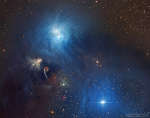 Stars and Dust in Corona Australis
12.01.2020
Cosmic dust clouds and young, energetic stars inhabit this telescopic vista, less than 500 light-years away toward the northern boundary of Corona Australis, the Southern Crown. The dust clouds effectively block light from more distant background stars in the Milky Way.
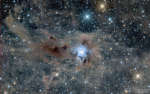 The Iris Nebula in a Field of Dust
1.08.2018
What blue flower grows in this field of dark interstellar dust? The Iris Nebula. The striking blue color of the Iris Nebula is created by light from the bright star SAO 19158 reflecting off of a dense patch of normally dark dust.
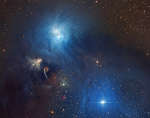 Stars and Dust in Corona Australis
7.01.2015
Cosmic dust clouds and young, energetic stars inhabit this telescopic vista, less than 500 light-years away toward the northern boundary of Corona Australis, the Southern Crown. The dust clouds effectively block light from more distant background stars in the Milky Way.
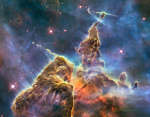 Dust Pillar of the Carina Nebula
26.04.2010
Inside the head of this interstellar monster is a star that is slowly destroying it. The monster, on the right, is actually an inanimate pillar of gas and dust that measures over a light year in length.
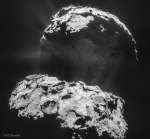 Comet CG Creates Its Dust Tail
12.07.2020
Where do comet tails come from? There are no obvious places on the nuclei of comets from which the jets that create comet tails emanate. One of the best images of emerging jets...
 APOD: 2025 January 14 Б North Star: Polaris and Surrounding Dust
14.01.2025
Why is Polaris called the North Star? First, Polaris is the nearest bright star toward the north spin axis of the Earth. Therefore, as the Earth turns, stars appear to revolve around Polaris, but Polaris itself always stays in the same northerly direction -- making it the North Star.
 Cosmic Rays and Supernova Dust
18.06.1998
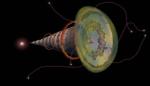
Cosmic Rays are celestial high energy particles traveling at nearly the speed of light, which constantly bombard the Earth. Discovered during high altitude balloon flights in 1912 their source has been a long standing mystery.
|
January February March April May June July August September October |
|||||||||||||||||||||||||||||||||||||||||||||||||