
|
You entered: dust
 APOD: 2023 April 11 Б North Star: Polaris and Surrounding Dust
10.04.2023
Why is Polaris called the North Star? First, Polaris is the nearest bright star toward the north spin axis of the Earth. Therefore, as the Earth turns, stars appear to revolve around Polaris, but Polaris itself always stays in the same northerly direction -- making it the North Star.
 Stars and Dust Across Corona Australis
12.09.2013
Cosmic dust clouds sprawl across a rich field of stars in this sweeping telescopic vista near the northern boundary of Corona Australis, the Southern Crown. Less than 500 light-years away the dust clouds effectively block light from more distant background stars in the Milky Way.
 Help Search for Interstellar Dust
25.10.2006
What caused that hole? The hole in question appears as a small dark circle on the far right. If the above image of aerogel seems dull and uninteresting, then welcome to one aspect of real world science.
 APOD: 2025 January 29 Б Dust Shells around WR 140 from Webb
28.01.2025
What are those strange rings? Rich in dust, the rings are likely 3D shells -- but how they were created remains a topic of research. Where they were created is well known: in a binary...
 Dust Pillar of the Carina Nebula
24.03.2013
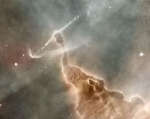
Inside the head of this interstellar monster is a star that is slowly destroying it. The monster, actually an inanimate pillar of gas and dust, measures over a light year in length. The star, not itself visible through the opaque dust, is bursting out partly by ejecting energetic beams of particles.
 Galaxy, Stars, and Dust
11.10.2015
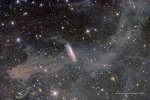
Is this galaxy trapped in a web of dust? No -- it is far in the background. However, spiky stars and spooky shapes are abound in this deep cosmic skyscape. Its well-composed field of view covers about a Full Moon on the sky toward the constellation Pegasus.
 Dust Pillars of the Carina Nebula
30.04.2007
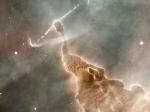
Inside the head of this interstellar monster is a star that is slowly destroying it. The monster, actually an inanimate pillar of gas and dust, measures over a light year in length. The star, not itself visible through the opaque dust, is bursting out partly by ejecting energetic beams of particles.
 Stars and Dust across Corona Australis
21.06.2023
Cosmic dust clouds cross a rich field of stars in this telescopic vista near the northern boundary of Corona Australis, the Southern Crown. Part of a sprawling molecular cloud complex this star forming region is a mere 500 light-years away.
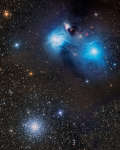 Stars and Dust Across Corona Australis
5.08.2021
Cosmic dust clouds cross a rich field of stars in this telescopic vista near the northern boundary of Corona Australis, the Southern Crown. Less than 500 light-years away the dust clouds effectively block light from more distant background stars in the Milky Way.
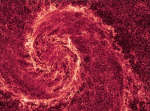 The Whirlpool Galaxy in Infrared Dust
25.01.2011
How do spiral galaxies form stars? To help find out, the Hubble Space Telescope imaged the nearby photogenic spiral M51 in infrared light to highlight the dust that traces the dense gas that best forms stars. To further isolate the dust, much of the optical light from stars has also been digitally removed.
|
January February March April May June July August September October |
|||||||||||||||||||||||||||||||||||||||||||||||||