
|
You entered: dust
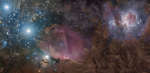 Orion in Gas, Dust, and Stars
29.09.2009
The constellation of Orion holds much more than three stars in a row. A deep exposure shows everything from dark nebula to star clusters, all imbedded in an extended patch of gaseous wisps in the greater Orion Molecular Cloud Complex.
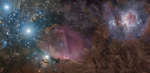 Orion in Gas, Dust, and Stars
12.02.2012
The constellation of Orion holds much more than three stars in a row. A deep exposure shows everything from dark nebula to star clusters, all embedded in an extended patch of gaseous wisps in the greater Orion Molecular Cloud Complex.
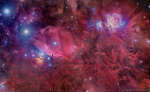 Orion in Gas, Dust, and Stars
10.11.2014
The constellation of Orion holds much more than three stars in a row. A deep exposure shows everything from dark nebula to star clusters, all embedded in an extended patch of gaseous wisps in the greater Orion Molecular Cloud Complex.
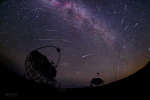 Gamma rays and Comet Dust
19.08.2016
Gamma-rays and dust from periodic Comet Swift-Tuttle plowed through planet Earth's atmosphere on the night of August 11/12. Impacting at about 60 kilometers per second the grains of comet dust produced this year's remarkably active Perseid meteor shower.
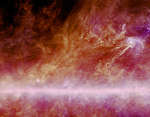 The Nearby Milky Way in Cold Dust
21.03.2010
What shapes the remarkable dust tapestry of the nearby Milky Way Galaxy? No one knows for sure. The intricate structures, shown above, were resolved in new detail recently in a wide region of the sky imaged in far infrared light by the European Space Agency's Planck satellite.
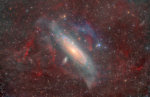 APOD: 2026 June 3 Б Andromeda Through Gas and Dust
2.06.2026
Over 1000 years ago, Persian astronomer Abd al-Rahman al-Sufi published humanityБs oldest known record of the Andromeda Galaxy in "The Book of Fixed Stars" (Bodleian Library MS. Marsh 144 p. 167). 800 years later, Andromeda became the 31st entry in Charles MessierБs "Catalogue of Nebulae and Star Clusters".
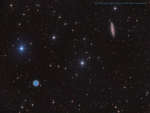 The Owl and the Galaxy
1.04.2015
The Owl and the Galaxy sail these skies With blue and yellow star. They go together beneath the Big Dipper, If you wonder where they are. The Galaxy's light shines through the night, Ten millions of light-years away. But never fear the Owl is near, Inside the Milky Way.
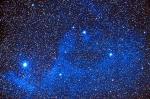 Starlight Reflections
14.04.1998
Wisps of dust fill the space between the stars. This dust is usually invisible, subtly acting to dim the light of more distant stars. Sometimes this dust is thick and prominent as dark patches on otherwise bright emission nebulae. Other times this dust may show itself by reflecting the light of bright, nearby stars.
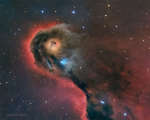 APOD: 2025 October 14 Б An Unusual Globule in IC 1396
13.10.2025
Is there a monster in IC 1396? Known to some as the Elephant's Trunk Nebula, parts of gas and dust clouds of this star formation region may appear to take on foreboding forms, some nearly human. The only real monster here, however, is a bright young star too far from Earth to hurt us.
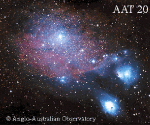 Nebulosity in Sagittarius
10.08.1997
What causes the colors in this beautiful nebulosity in Sagittarius? Dubbed NGC 6589 and NGC 6590, the colors of this nebulosity, are caused by gas and dust. The blue color of the nebula nearest the bright stars is caused by reflection off interstellar dust.
|
January February March April May June July August September October |
|||||||||||||||||||||||||||||||||||||||||||||||||