
|
You entered: dust
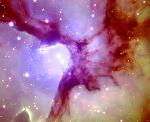 In the Center of the Trifid Nebula
26.06.2002
Clouds of glowing gas mingle with lanes of dark dust in the Trifid Nebula, a star forming region toward the constellation of Sagittarius. In the center, the three huge dark dust lanes that give the Trifid its name all come together.
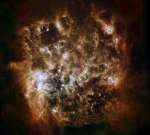 Infrared Portrait of the Large Magellanic Cloud
15.01.2012
Cosmic dust clouds ripple across this infrared portrait of our Milky Way's satellite galaxy, the Large Magellanic Cloud. In fact, the remarkable composite image from the Herschel Space Observatory and the Spitzer Space Telescope show that dust clouds fill this neighboring dwarf galaxy, much like dust along the plane of the Milky Way itself.
 Infrared Portrait of the Large Magellanic Cloud
23.03.2013
Cosmic dust clouds ripple across this infrared portrait of our Milky Way's satellite galaxy, the Large Magellanic Cloud. In fact, the remarkable composite image from the Herschel Space Observatory and the Spitzer Space Telescope show that dust clouds fill this neighboring dwarf galaxy, much like dust along the plane of the Milky Way itself.
 Infrared Portrait of the Large Magellanic Cloud
14.01.2016
Cosmic dust clouds ripple across this infrared portrait of our Milky Way's satellite galaxy, the Large Magellanic Cloud. In fact, the remarkable composite image from the Herschel Space Observatory and the Spitzer Space Telescope show that dust clouds fill this neighboring dwarf galaxy, much like dust along the plane of the Milky Way itself.
 Streaming Dark Nebulas near B44
15.06.2009
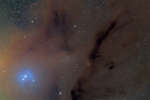
Dark dust lit by the bright yellow star Antares highlight this photogenic starscape of the southern sky. A wider angle image shows the central band of our Milky Way Galaxy connected to Antares by streams of dust knows as the Dark River. At the head of the Dark River the dust appears in dense knots.
 Composing the Omega Nebula
11.12.2000
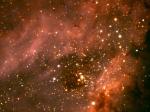
The Omega Nebula is a massive, complex cloud of dust and gas from which new stars are continually forming. The similarity to the Greek letter capital Omega gives the molecular cloud its popular name, but the nebula is also known as the Swan Nebula, the Horseshoe Nebula, and M17.
 M78: Stardust and Starlight
4.11.2005
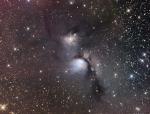
Interstellar dust clouds and bright nebulae abound in the fertile constellation of Orion. One of the brightest, M78, is just below center in this sharp widefield view, covering an area north of Orion's belt. At a distance of about 1,500 light-years, the bluish nebula itself is about 5 light-years across.
 Reflecting Merope
6.12.2000
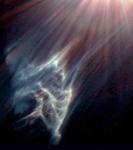
In the famous Pleiades star cluster, a star's light is slowly destroying a passing cloud of gas and dust. The star, Merope, lies just off the upper right edge of this recently released picture by the Hubble Space Telescope.
 The Pleiades Deep and Dusty
14.11.2017
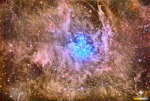
The well-known Pleiades star cluster is slowly destroying part of a passing cloud of gas and dust. The Pleiades is the brightest open cluster of stars on Earth's sky and can be seen from almost any northerly location with the unaided eye.
 The Galactic Center in Infrared
8.07.2001
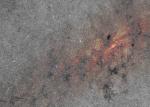
The center of our Galaxy is a busy place. In visible light, much of the Galactic Center is obscured by opaque dust. In infrared light, however, dust glows more and obscures less, allowing nearly one million stars to be recorded in the above photograph.
|
January February March April May June July August September October |
|||||||||||||||||||||||||||||||||||||||||||||||||