
|
You entered: color
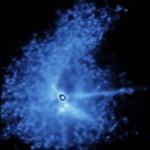 The T Tauri Star Forming System
4.06.2001
What did the Sun look like before there were planets? A prototype laboratory for the formation of low mass stars like our Sun is the T Tauri system, one of the brighter star systems toward the constellation of Taurus. In young systems, gravity causes a gas cloud to condense.
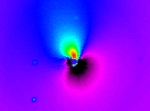 A Dust Jet From Hale-Bopp
29.07.1996
Approaching the inner Solar System, comet Hale-Bopp's icy nucleus is heated by sunlight, accelerating its production of dust and gas. Shrouded in the resulting cloud, known as the coma, the cometary nucleus remains hidden from direct view.
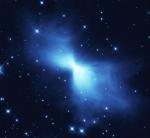 Cold Wind from the Boomerang Nebula
20.02.2003
A cold wind blows from the central star of the Boomerang Nebula. Seen here in a detailed false-color image recorded in 1998 by the Hubble Space Telescope, the nebula lies about 5,000 light-years away towards the grand southern constellation of Centaurus.
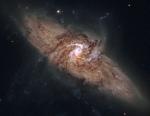 NGC 3314: When Galaxies Overlap
7.05.2005
NGC 3314 consists of two large spiral galaxies which just happen to almost exactly line-up. The foreground spiral is viewed nearly face-on, its pinwheel shape defined by young bright star clusters. But against the glow of the background galaxy, dark swirling lanes of interstellar dust are also seen to echo the face-on spiral's structure.
 Ring Scan
24.10.2007
Scroll right and cruise above the thin, icy rings of Saturn. This high resolution scan is a mosaic of images presented in natural color and recorded in May, over about 2.5 hours as the Cassini spacecraft passed above the unlit side of the rings.
 Aristarchus Plateau
30.11.2007
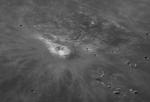
Anchored in the vast lava flows of the Moon's Oceanus Procellarum lies the Aristarchus Plateau. The bright impact crater at the corner of the plateau is Aristarchus, a young crater 42 kilometers wide and 3 kilometers deep. Only slightly smaller, lava flooded Herodotus crater is above and to the left.
 Martian Dunes and the Shadow of Opportunity
24.03.2009
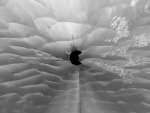
Human made robots continue to roll across the surface of Mars. Both Opportunity and its sister rover Spirit are in their sixth year on Mars, exploring the red planet for years longer than original expectations.
 VdB 152: Reflection Nebula in Cepheus
31.10.2009
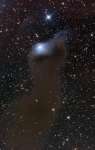
Described as a "dusty curtain" or "ghostly apparition", mysterious reflection nebula VdB 152 really is very faint. Far from your neighborhood on this Halloween Night, the cosmic phantom is nearly 1,400 light-years away. Also cataloged as Ced 201, it lies along the northern Milky Way in the royal constellation Cepheus.
 Pelican Nebula Close Up
19.08.2010
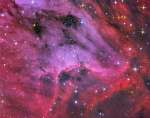
The prominent ridge of emission featured in this intensely colorful skyscape is designated IC 5067. Part of a larger emission nebula with a distinctive shape, popularly called The Pelican Nebula, the ridge spans about 10 light-years and follows the curve of the cosmic pelican's head and neck.
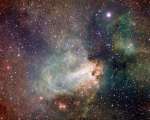 Star Factory Messier 17
30.06.2011
Sculpted by stellar winds and radiation, the star factory known as Messier 17 lies some 5,500 light-years away in the nebula-rich constellation Sagittarius. At that distance, this degree wide field of view spans almost 100 light-years, courtesy of ESO's new VLT Survey Telescope and OmegaCAM.
|
January February March April May June July August September October |
|||||||||||||||||||||||||||||||||||||||||||||||||