
|
You entered: color
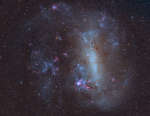 The Large Cloud of Magellan
5.09.2019
The 16th century Portuguese navigator Ferdinand Magellan and his crew had plenty of time to study the southern sky during the first circumnavigation of planet Earth. As a result, two fuzzy cloud-like objects easily...
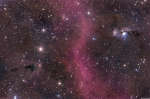 Decorating the Sky
12.12.2019
Bright stars, clouds of dust and glowing nebulae decorate this cosmic scene, a skyscape just north of Orion's belt. Close to the plane of our Milky Way galaxy, the wide field view spans about 5.5 degrees. Striking bluish M78, a reflection nebula, is on the right.
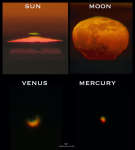 Green Flashes: Sun, Moon, Venus, Mercury
30.05.2020
Follow a sunset on a clear day against a distant horizon and you might glimpse green just as the Sun disappears from view. The green flash is caused by refraction of light rays traveling to the eye over a long path through the atmosphere.
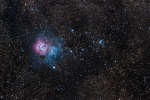 Messier 20 and 21
6.08.2020
The beautiful Trifid Nebula, also known as Messier 20, is easy to find with a small telescope in the nebula rich constellation Sagittarius. About 5,000 light-years away, the colorful study in cosmic contrasts shares this well-composed, nearly 1 degree wide field with open star cluster Messier 21 (right).
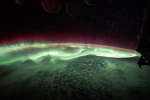 APOD: 2026 May 16 Б Aurora Slathers Up the Sky
16.05.2026
Like salsa verde on your favorite burrito, a green aurora slathers up the sky in this 2017 June 25 snapshot from the International Space Station. About 400 kilometers (250 miles) above Earth, the orbiting station is itself within the upper realm of the auroral displays.
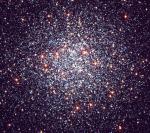 M55: Globular Star Cluster
22.09.2000
The fifty-fifth entry in Charles Messier's catalog, M55 is a large and lovely globular cluster of around 100,000 stars. Only 20,000 light-years away in the constellation Sagittarius, M55 appears to earth-bound observers to be nearly 2/3 the size of the full moon.
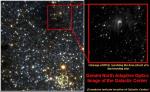 Gemini North Images Bow Shock Near Galactic Center
17.10.2000
What's going on near the center of our Galaxy? Glowing across the electromagnetic spectrum, the center of our Milky Way Galaxy is thought to be home to massive stars, rotating gas rings, and a massive black hole. Now the central Galactic zoo just got larger.
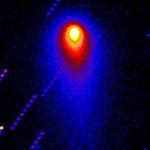 Comet Stonehouse
14.05.1998
Comets move against a field of background stars. Their apparent motion is slow but carefull tracking reveals their orbits, allowing these visitors to the inner solar system to be identified as old or new acquaintances. Recently a new comet, designated 1998 H1, was discovered by observer Patrick L.
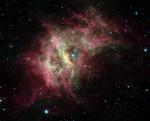 Cosmic Construction Zone RCW 49
3.06.2004
Stars and planets appear to be under construction in dusty nebula RCW 49. This Spitzer Space Telescope false-color infrared view of the nearby stellar nursery shows that known, hot stars are well on their way to clearing out the nebula's central regions.
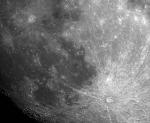 Tycho and Copernicus: Lunar Ray Craters
5.03.2005
Dazzling in binoculars or a small telescope, the Moon is pocked with impact craters. During partial lunar phases, the craters along the terminator are cast in dramatic relief by strong shadows. But when the Moon is full some craters seem to sprout systems of bright radial lines or rays.
|
January February March April May June July August September October |
|||||||||||||||||||||||||||||||||||||||||||||||||